
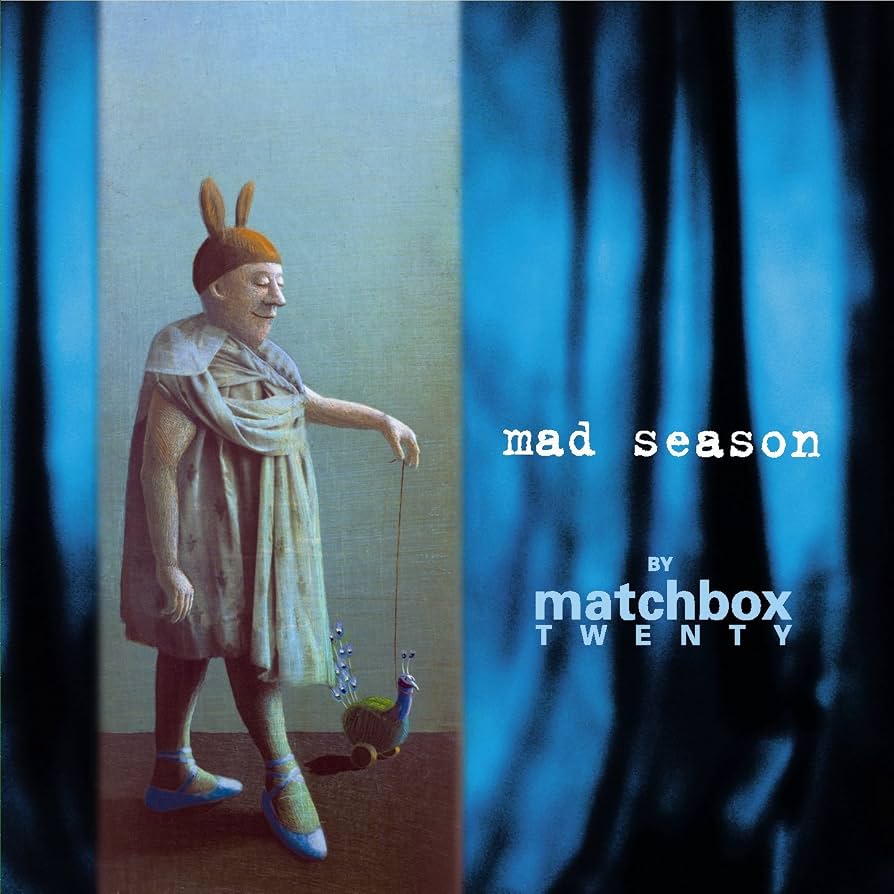
In early 1990s Rob Thomas moved to Orlando, Florida and played in a bunch of local bands (including Tabitha’s Secret) with his buddies, bassist Brian Yale and drummer Paul Doucette. After a few years, they formed another group which they called Matchbox Twenty, adding guitarists Kyle Cook and Adam Gaynor. Their debut was called Yourself or Someone Like You and it went on to sell something like ten million copies. But front and centre was Thomas’ vocals and songwriting talent which helped propel the band’s appeal with millennials.
In a Forbes interview in 2025, Rob Thomas was asked by Steve Baltin, “Do you have a recurring theme in your writing?” Thomas replied, “I think that I’ve written songs for years just about how people relate to each other. I’ve been writing songs about moments that all of us have and then how those moments make you.” Later he would add that, “It’s my job to write about how that thing makes me feel because you probably understand that feeling.”
His insights about relationships are often refreshingly honest. Songs like Push, This Is How a Heart Breaks, Disease and Rest Stop are very expressive examples of songs that ordinary people can, as Thomas says, “attach it to their lives in whatever way they see fit.” Luckily for us he has elaborated about some of the songs he has written over the years as part of his solo shows.
More specifically he has referenced many songs he has written about himself and his wife. One of the finest tracks from Matchbox Twenty’s sophomore album Mad Season is the soaring, orchestral-inflected ballad If Your Gone, a song Thomas wrote as a letter to his wife about the fear of losing her because of the mounting pressure of touring, fame and Thomas’ own anxieties. Other Thomas-penned songs about his wife, whom he married in 1999, include Her Diamonds (2009) and Ever the Same(2005), which reflect upon his wife’s health battles. Famously his most over-the-top moment came with his collaboration with Santana on Smooth (1999), where he references Marisol as his “Spanish Harlem Mona Lisa” and “My Muñequita” which translates to “My Little Doll” in Spanish.
On Mad Season, another song that was inspired in part by Thomas’ wife, comes late on the album. For some twenty-plus years it still stands as one of my favourite Matchbox Twenty song. But You Won’t Be Mine isn’t a Matchbox Twenty song which is often held in high regard by fans. That fact really surprises me. It’s rarely mentioned in top ten or fan-voted lists. Most fans seem to steer towards the band’s more radio friendly hits and deep-cuts like Back 2 Good. While I won’t name fans by name online, I did come across a fan who attempted to rank every Matchbox Twenty song (as of 2023). You Won’t Be Mine was ranked only the 52nd best Matchbox Twenty song. While they ranked Unwell at #1 and its a deserved song to be held in such high regard with its deeply resonant lyrics about mental health, I honestly feel like their dismal ranking of You Won’t Be Mine is a travesty.
Evanescence’s My Immortal is the grittier melancholic example of how good orchestral rock songs can be. Like You Won’t be Mine, My Immortal plays on listener’s emotions. Both songs actually have a lot in common. For instance, piano chords are paired with sweeping string sections, themes of loss and lingering presence permeate throughout the lyrics and each track begins with a quiet, restrained performance, respectively from Amy Lee and Thomas, before swelling with an emotionally-charged vocal climax. Of course, My Immortal is the more famous rock ballad of the two, which bursts sonically into a heavy rock track with guitars and crushing drums, while You Won’t Be Mine remains an understated deep-cut. Honestly, You Won’t Be Mine is a song I could see Billy Joel singing, crouched over a piano with all the sincerity and authenticity the song deserves.
Frequently highlighted in interviews but primarily on stage, Thomas has said You Won’t Be Mine is one of his favourite songs from the band’s discography. I get it Rob. It’s a great song and arguably one of the best he has ever written. There is definitely nothing else like it. It feels like an outlier from the band’s repertoire with its dramatic shift in tone and lush orchestral arrangement. Musically, it stands out because of Thomas’ unhurried blues-infused, so-called late-night club piano and his gritty, raspy and conversional rich baritone, which begins with the lyrics “Take your head around the world, see what you get from your mind.” But it is the emotional weight of a 68-piece orchestra which carries this song from being just a mere ballad into a full blown cinematic marvel.
On the original album (I still have it on CD) upon conclusion of the song (at some 5 and a half minutes), after a pause which feels like forever, an orchestral reprise kicks in, adding a sweeping bittersweet conclusion to the song. Listen to it HERE.
On a rainy and thunderous Sunday late afternoon with nothing better to do, some twenty-plus years ago, I still vividly remember sitting lounging around listening to You Won’t Be Mine. Back then, it dawned on me I hadn’t properly listening to this song. All of a sudden in the gloom of the failing light, I realised what a sad but beautiful song it really was. Now every time I hear the piano kick in, all I hear is a melody of pattering rain. Moreover, that deep rolling rumble made by the orchestra bass drum and timpani perfectly imitates the sound of distant rolling thunder that I heard that Sunday afternoon. I’m sure I’m not the first to pick up on this.
Of course, the emotional weight of this song doesn’t just belong to the sweeping orchestral arrangement of the Nashville String Machine. It belongs to Thomas prowess of piecing together the often difficult realities and twist and turns that govern life. Thomas once joked about how he wrote You Won’t Be Mine, after a dumb fight he had with his wife. “Baby, baby wake up and listen to this song about the fight we just had… when I hated you, about an hour ago,” he once said at The Music Box, concert hall in Atlantic City.
But in all seriousness, that argument led to an introspective moment with Thomas writing a song about the weight of letting go of someone who doesn’t care about them any more. Moreover, the painful realisation is that this person (whoever it is) will undoubtedly move on and flourish without them. I especially like the song’s refrain which spells it out – “Over the lies, you’ll be strong/ Rich in love and you will carry on/ But, no, oh, no/ No, you won’t be mine.”
If I am to make one more observation, two key lyrics in the song continue to haunt me over and over. Both are symbolic, to the point and capture what it is to be arguably stubborn and lonely. The first is found in the second verse: “Take your straight line for a curve/ Make it stretch, the same old line.” And the second lyric and arguably my favourite line says: “Take yourself out to the curb/ Sit and wait, a fool for life.”
I guess this song is as much as about heartbreak and mourning as it is about acceptance and finding strength to move on. It’s a deeply bittersweet love song. Don’t take my word for it. Please listen to the moody brilliance of You Won’t Be Mine for yourself.


0 comments on “Classic songs: ‘You Won’t Be Mine’ by Matchbox Twenty.”