
Pavle “Paja” Jovanović was a very successful and prolific Serbian painter of the late 19th and early 20th century. While he focused most of his time painting subjects and events related to Serbian history, such as his iconic painting Migration of the Serbs (1896), a dramatic depiction of the 1690 exodus of Serbs, he was also one of the most sought-after portraitist of prominent citizens and royalty of that era. He painted the Emperor Franz Joseph I of Austria on many occasions. He died in Vienna, Austria in 1957 at the age of 98. Alongside Uroš Predić and Đorđe Krstić his legacy is cemented as one of the most important Serbian painters of realism.
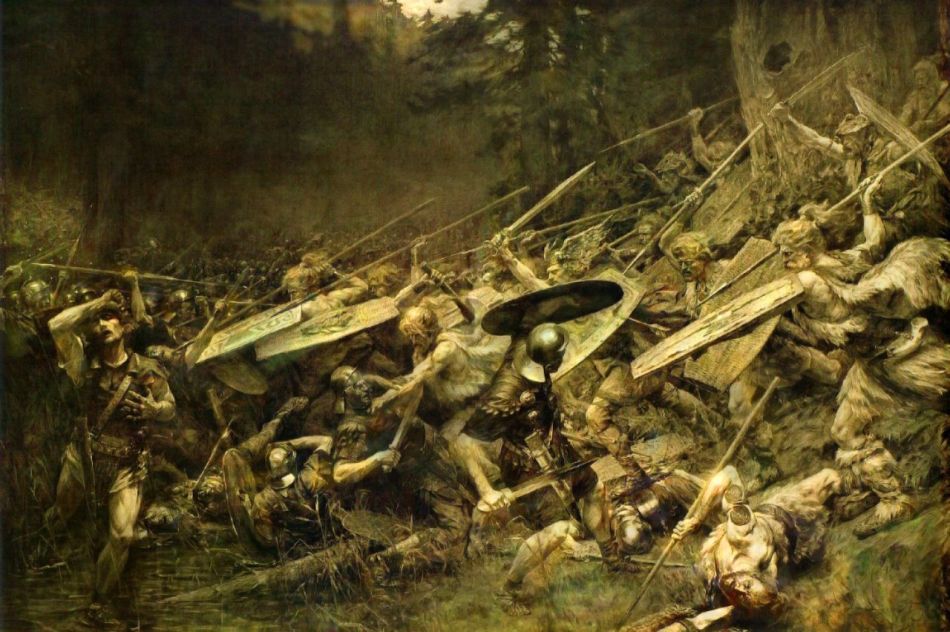
In 1899 “Paja” Jovanovic painted “Furor Teutonicus” depicting the battle of the Teutoburg Forest wherein an alliance of Germanic tribes led by Germanic chieftain Arminius ambushed and annihilated three Roman legions. The award winning, monumental 24 square metres oil painting, mysteriously disappeared in 1910 after being in the possession of the Chilean National Museum of Fin Arts. Today only a small sketch of the painting has survived. I don’t know where the replica is displayed. I presume it’s in a Belgrade museum, possibly the Museum of Paja Jovanovic. I also don’t know why he chose to paint the Battle of the Teutoburg Forest on such as massive-scale. His personal motivations, in particular. Paintings such as Jovanovic’s “Furor Teutonicus” were often designed for major exhibitions. It is my understanding that he may have been encouraged to produce such a monumental historical painting out of some sort of obligation to his fellow citizens or trend at the time.
For Roman history buffs the Battle of the Teutoburg Forest stands as one of the most significant watershed moments in antiquity. But for those who are not familiar with this defining historical event, here below is a brief outline.
The expansion of the Roman empire must have seemed limitless to generations of Romans. Nearing the end of the first century BC, the Romans had conquered vast swaths of territory from Gaul in the west to Anatolia in the east. Under Emperor Augustus, around 12 BC, Roman ambitions of further conquest reached new heights with important plans to conquer and expand the German frontier from the Rhine river to the Elbe river.
In short, the troublesome task of subjugating the German tribes over nearly two decades went reasonably well. But eventually Rome’s arrogance and mistreatment of the tribes they had tried to pacify, between the Rhine and Elbe Rivers, spilled over into deep resentment and eventually open rebellion.
Led by a Germanic chieftain named Arminius, who once served in the auxiliary of the Roman army, the German tribes planned to take back their lands in a brilliant coordinated ambush during the autumn (likely September) in the year 9 CE. The crafty Germans realising they were no match for the Romans in open battle, set a trap for the Romans in the Teutoburg Forest, near the area around Kalkriese Berg. This narrow wooden pass would act to stop the Romans from forming any kind of defensive formation.
Once the Romans were deep within the forest, Arminius gave the signal for Germanic warriors to attack the Roman legions who stumbled their way through the forest, truly unaware of the fate that awaited them. By the end of the ambush, the vengeful Germanic warriors had annihilated three Roman legions, in which huge numbers of men perished, possibly 15,000 in all, including the Roman general Publius Quinctilius Varus.
Only a handful, maybe even a few hundred men escaped the carnage. When they returned home and spoke of what had happened, it completely shocked the Roman world. In the wake of the massacre, the Germans proceeded to wipe out Roman garrisons and forts east of the Rhine and for years the Romans were unable to make progress in subduing the Germanic tribes. The ambush in a nutshell stopped the northern expansion of the Roman empire, convincing Augustus that the empire was probably its most practical limits of expansion.
In his book Twelve Caesars, the Roman historian Gaius Suetonius Tranquillus tells us how in the aftermath of the battle Augustus refused to shave and cut his hair for months at a time out of respect for his lost legions. He also apparently walked the halls of his house alone at night mumbling and wailing, “Quinctilius Varus, give me back my legions!”.
The popularity surrounding the glorification and power of the Germanic people, especially the events surrounding the Battle of the Teutoburg Forest, was something that was encouraged or in vogue in national programs of the 19th century in Europe. I can only imagine what it would have felt like to stand in front of such a large scale painting as the “Furor Teutonicus”. To create such a unique history painting would have been a daunting proposition, especially in all the fine details which would go onto depict the chaotic nature of the battle. Just take a look at the main elements in focus in the surviving sketch. Several things catch our eye immediately. Firstly, the overwhelming grouping of Germanic warriors with their spears thrusted at the Romans is very dramatic. The tilt of their shields also act as a weapon, helping distancing their bodies away from any wayward Roman sword. In contrast, the Romans appear taken aback and completely surprised by the attack. Moreover the close-quarter combat or the “scrum’ makes the scene feel chaotic and completely claustrophobic. This is of course enhanced by the harsh terrain of the Teutoburg Forest.
I want to comment on two more elements in the painting which interests me. The Roman soldier (on the left in the foreground) with his hand over his heart and holding his head back in shock and disbelief is likely the Roman general Publius Quinctilius Varus. Roman historian Suetonius tell us that upon realising the error his ways of leading his men through the unforgiving forest, Varus committed suicide by falling on his own sword. He did so to avoid the humiliation of capture, surrender and the political disgrace of losing three of Rome’s finest legions. And if this isn’t Varus, the soldier instead stands as a symbolic gesture of the plight of the whole doomed legions. The Germanic warrior with the winged helmet, partially hidden by a Roman soldier holding up his shield, is without a doubt the Germanic chieftain Arminius. Jovanovic was likely inspired by a romantic representation of a winged-helmeted Armnius by artists of his time. It’s hard to say whether he was inspired by another sketch or not. The most obvious inspiration could have been Ernst von Bandel’s Hermann Memorial which was completed in 1875 to commemorate Arminius’ victory over the Romans. On top of the monument a striking giant bronze status of a winged helmeted Arminius stands steadfast as a symbol of both German pride and unity.
Jovanovic’s history painting “Furor Teutonicus’’, particularly its scale, careful compositional arrangements and nod to history makes this one of the finest paintings I’ve looked at for this series so far. Moreover what’s great about Jovanovic is that he was a prolific painter, which means there’s plenty more of the Serbian’s work to feature in this series.
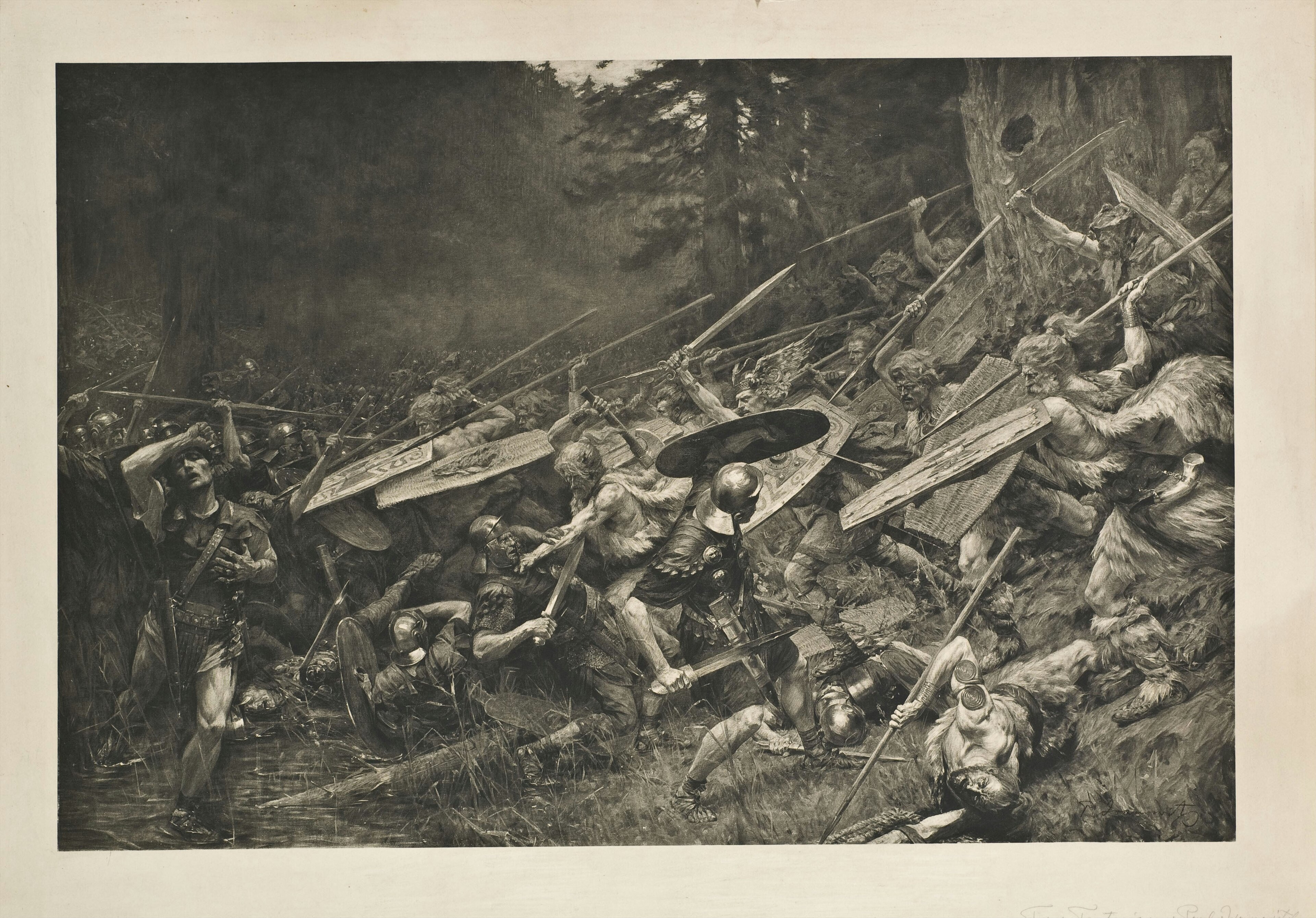
This sketch of the painting is in the public domain.
*The core of this featured article was originally written in 2018 and formed the basis of a now defunct short article I had written on the Battle of the Teutoburg Forest. It has since been edited and expanded into this new article for my History Painting series.


Fascinating !
This Roman-style “epic fury” is truly impressive. I wasn’t familiar with this painting at all, and even less so with this painter whose imagery may have inspired Ridley Scott for the grand opening sequence of his ancient “Gladiator.”
I’ve learned a lot from reading this article, and I thank you for it.🙏
The connection between history and art is often moving. I think it helps us bring the past back to life. I’m thrilled you got something out of it.
It’s remarkable that Jovanović would have painted such an immense work as this, and even more so for it to have vanished in 1910 after being in the possession of an art museum in Chile of all places.