
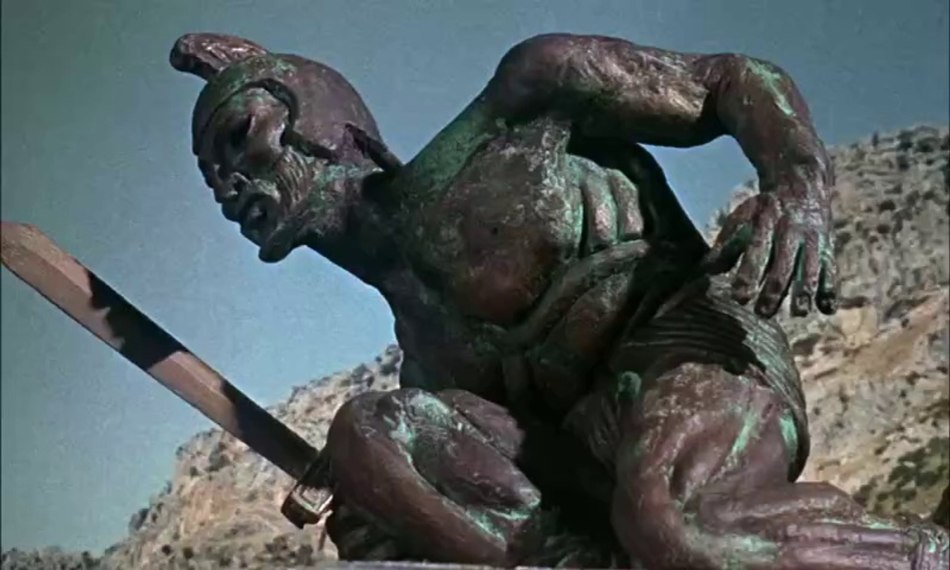
British film and television director Don Chaffey (1917-1990) is best remembered for his fantasy films, which include The Three Lives of Thomasina (1963), One Million Years B.C. (1966), Raquel Welch’s first feature film and the children’s classic Pete’s Dragon (1977) for Walt Disney. I would hesitate to call him a great director. He was more a prolific journeyman and well liked but mediocre at best. Though his best directorial effort by a long shot is his 1963 classic fantasy film Jason and the Argonauts. While Chiefly workmanlike stint behind the camera is solid, he is unfortunately overshadowed by Ray Harryhausen’s stop-motion magic and storytelling. Harryhausen elevates Jason and the Argonauts to greatness by transforming it from a mere “sword and sandal” affair into a revered cult classic. He gives it a heart as big as a giant bronze Talos.
When Tom Hanks presented Harryhausen an honorary Oscar in 1992, he said, “Some say Citizen Kane is the greatest motion picture of all time, others say it’s Casablanca. For me, the greatest picture of all time is Jason and the Argonauts.” I’m sure Hanks felt obliged to make such a call in his acclaim for the movie. Lets face it, it was probably scripted for him, especially because he was just about to salute a pioneer who single-handedly revolutionised stop-motion filmmaking and inspired a generation of filmmakers who followed in his footsteps. Beginning in the 1950s across 16 films, many of Harryhausen’s movies today are cult classics. They include the likes of Earth vs. the Flying Saucers (1956), The 7th Voyage of Sinbad (1958) and Clash of the Titans (1981). Tom Hanks well-intentioned salute to Harryhausen shouldn’t be dismissed as a staged throw away line (even though Hanks has admitted repeatedly since that 2001: A Space Odyssey is his favourite movie of all time). Others, including Tim Burton, Steven Spielberg, George Lucas, James Cameron and Peter Jackson (no offence Tom Hanks) have all payed their respects to Harryhausen unreservedly.
Beetlejuice and The Nightmare Before Christmas director Tim Burton once said Jason and the Argonauts was his first cinematic experiences as a child. He also recalled how “( Harryhausen’s) monsters had more personality than most of the actors in the movies. Even if the monster was just a monster; the death scene was always just so beautiful and tragic. The final little twist of the tail or the one final breath or whatever.” Star Wars creator George Lucas weighed in on Harryhausen’s legacy too by noting how “Ray has been a great inspiration to us all in special visual industry.” This sentiment is also shared by Spielberg and Cameron. While Peter Jackson called his own epic Lord of the Rings trilogy his “Ray Harryhausen movie”.
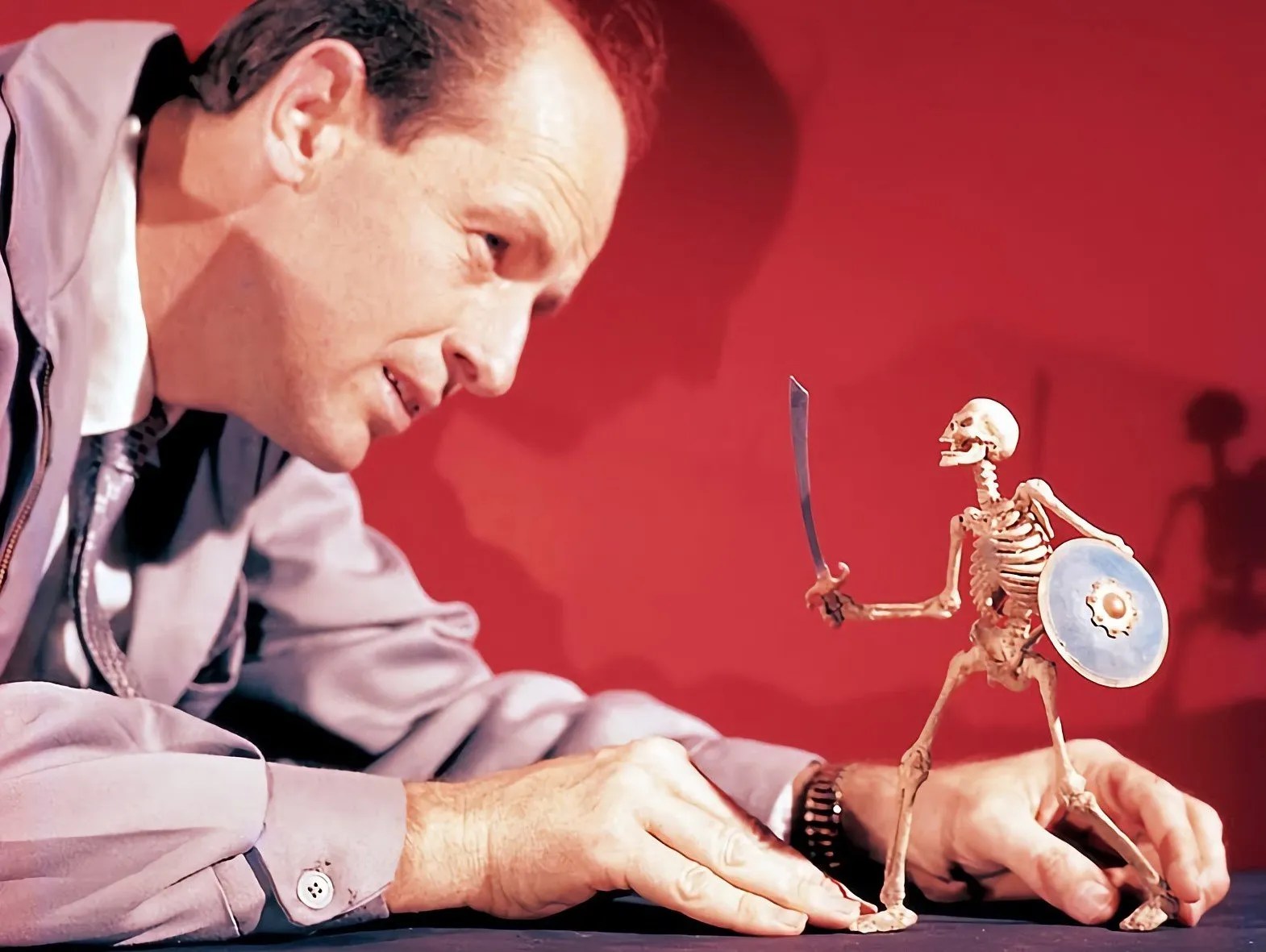
Recently I sat down to watch 1963’s Jason and the Argonauts. It was my sixth time under its spell, but some twenty years in between the last time I saw it. Before I hit play I wondered what I would remember about it. For the record I’m not an expert on Greek mythology but like all good stories about ancient Greece and the gods I knew I wouldn’t be disappointed. And I wasn’t! I dare you not to like it! If you read my blog you may have noticed I’ve already tackled its most dynamic scene which comes late in the film where Jason and the Argonauts battle the skeleton warriors.
Loosely based on the Greek poem from the 3rd century BCE called Argonautica, Chaffey’s fantasy-adventure about Jason’s quest to find the Golden Fleece takes liberties with what ends up on screen. And for good reason. There was a lot to condense and even omit from the Greek poem considering Jason and the Argonauts was released as a ‘G’ rated family movie. For one, the classic poem has a tragic ending. Scratch that! We don’t want a dead hero. Secondly, I’m not so sure how Jason’s romp on the island of Lemnos entirely populated by women on the first stop of their voyage could be satisfactorily explained to a five year old kid! Scratch that too! To sidestep some of these problematic moment from the poem, the producers of the movie would need to distract us with a little more fun and adventure. I guess this is where the brilliant classic US one-sheet movie poster for film helped sell its credentials with its tagline: “The epic story that was destined to stand as a colossus of adventure!” The lurid detail of the poster especially the sight of the Talos flexing his sword would have been enough to stir the imagination of any moviegoer.
The film’s opening sets the scene how and why Jason, the son of the murdered King Aristo of Thessaly, is spared as an infant. The story next jumps forward some twenty years later as Jason returns to his homeland to avenge the death of his family. Here on his arrival he unwittingly saves the usurper Pelias (who stole the throne from his father) from drowning in a river. Disguising his true identity from Jason, Pelias invites the young heir to his camp, where he learns Jason wants to kill the tyrant king. To rid himself of Jason, Pelias encourages the young noble to seek out the legendary Golden Fleece in a far away mythical land called Colchis. Only then will he truly succeed in restoring justice and peace to Thessaly. When Pelias’ son Acastus asks his father why he just doesn’t eliminate Jason, Pelias points out that an oracle once warned him if he tried to kill Jason it would lead to his own downfall. (Jason is protected by the gods specifically Hera.) Therefore by instructing Jason on a suicidal mission to retrieve the Golden Fleece, Pelias could wash his hands of the matter.
On Mount Olympus, the king of the gods Zeus and his wife Hera watch over events in a magical pool. More than anything the goddess Hera wants revenge on Pelias for defiling her temple decades earlier during his purge of Thesasaly. To exact her payback she uses Jason as her tool to do so. But her motivations aren’t so cut and dry. She is also very fond of him and acts as his devoted guardian and mentor. Jason will especially need her help on his perilous journey to fetch the Golden Fleece. He will be allowed to call on her for help only five times. A pleasing detail of the film is the stylised painted bust of Hera on Jason’s vessel (the Argo) which was mounted on the stern by the shipbuilder Argos. Here she sits towering over the argonauts as their protector. But before Jason sets off on his journey he must also recruit a crew of elite heroes. A competition is staged across ancient Greece to find the most cunning and strongest men who will join him. Among the chosen few Jason enlists Hercules to join his heroic band of brothers. But as you will discover this isn’t Hercules movie to shine. He leaves the Argonauts quest early. The gods have something else in mind for him.
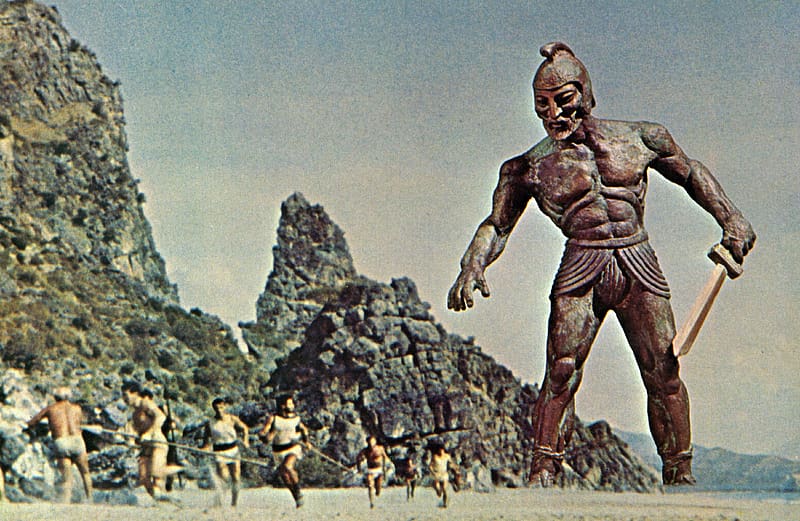
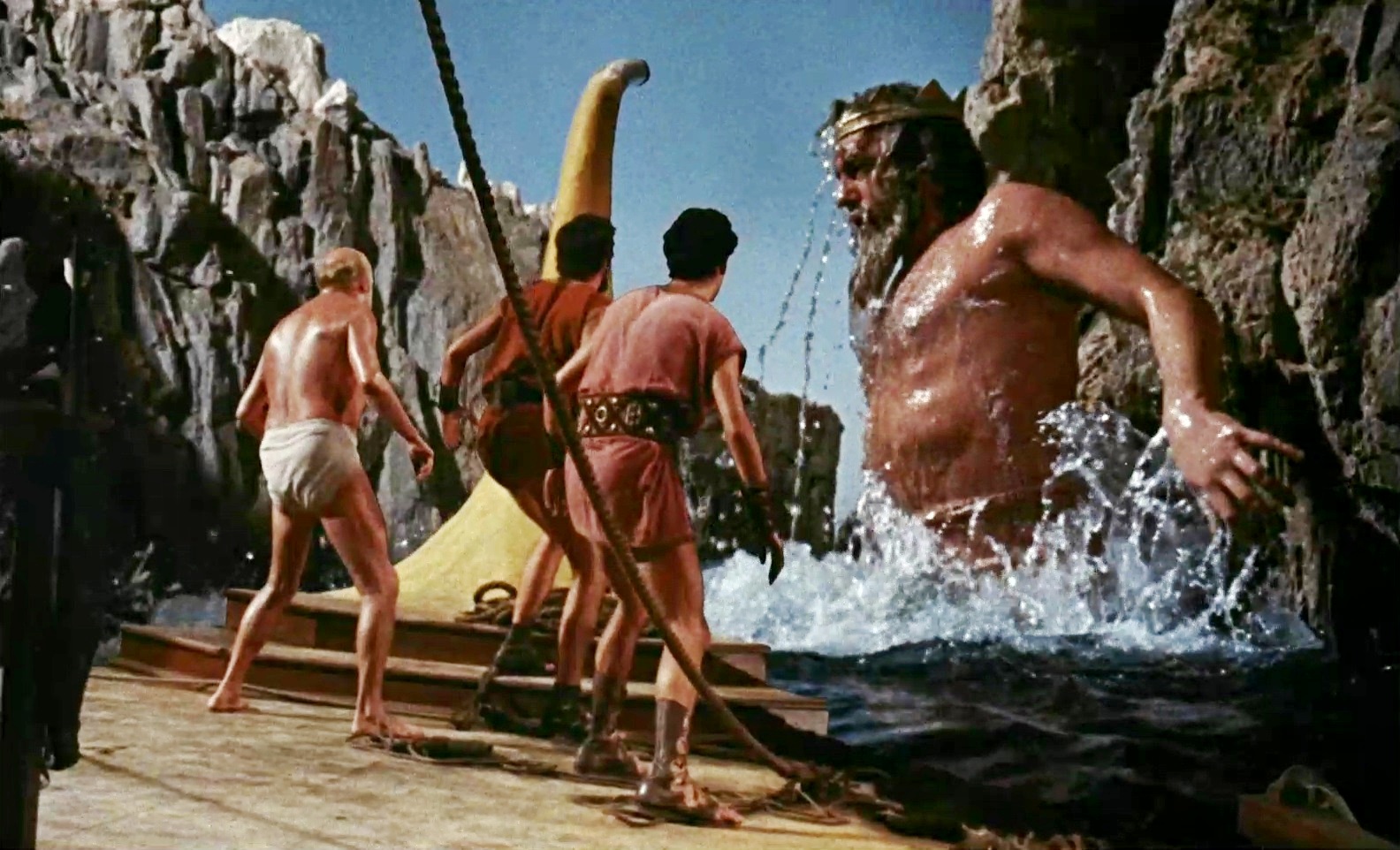
From the get-go trouble finds Jason and his companions on the high seas. On their first stop, after being warned by Hera to collect only the bare essentials needed for their journey, they encounter the giant Talos on the Isle of Bronze. He is awakened from his crouching slumber overlooking the island because Hercules dared to steal a brooch from a treasure chamber. The sight of the creaking, ungainly, giant bronze Talos is forever burned in my mind as one of Harryhausen’s most iconic stop-motion creations. Lets face it. He is very impressive! But he is far from being a maniacal brute. Yeah sure he is a little bit scary. But you can’t blame him for being a bit hot under the collar. When Jason and his cohort attempt to escape the island, Talos smashes the Argos to pieces. Floating in the wreckage of the ship, Jason finds Hera’s bust and asks for help. She advises him to remove a large plug from the giants ankle which will release the magic life-giving molten ichor which powers him.
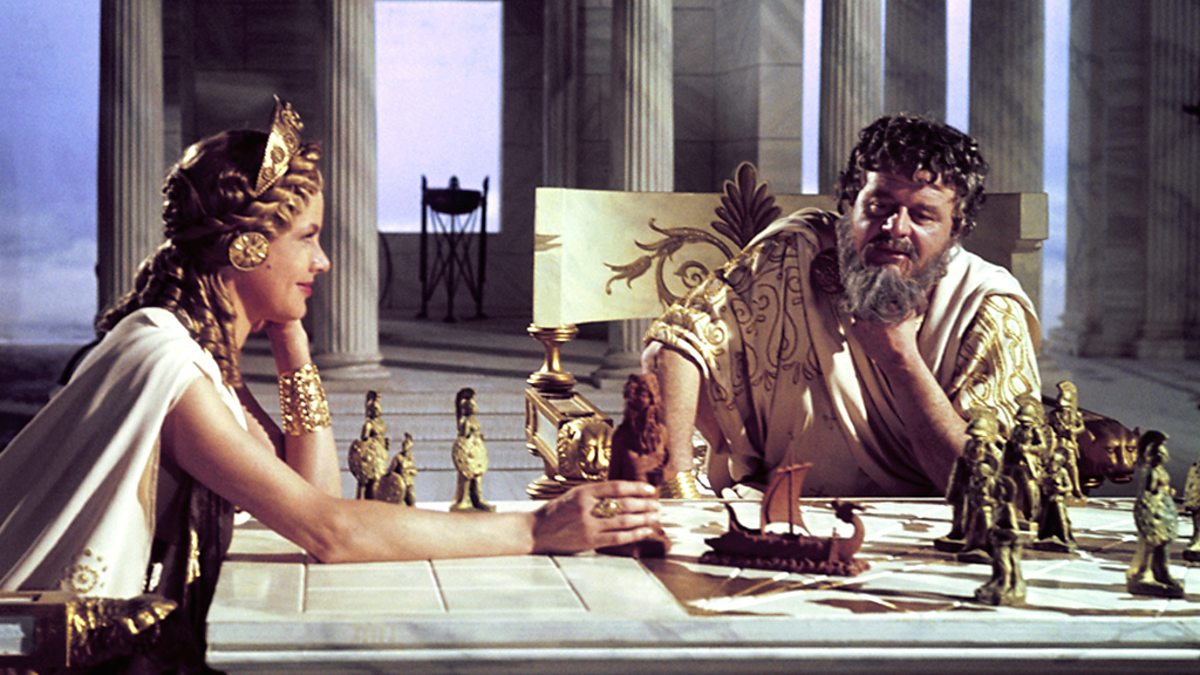
The scenes with the gods and how they get their kicks toying with Jason’s life as if he were a pawn in their marital chess game are some of the more comical and intriguing scenes. Perfectly cast as Zeus, Irish actor Patrick Niall Macginnis of Martin Luther (1953) fame, brings an air of arrogance that is needed to play the king of gods. His counterpart Honor Blackman as the goddess Hera is very much Zeus’ match. Best known for her role in The Avengers (a British spy tv series between 1962-64) and as Pussy Galore in the James Bond thriller Goldfinger (1964) Blackman’s extraordinary screen presence makes every frame she is in worth watching intently. As Hera she is not only beautiful but intelligent and strong-willed. When the argonauts are trapped and cannot pass through the “clashing rocks” of the Bosphorus Strait, Hera moves a strategic chess piece into play to help Jason. She calls upon Triton, the Greek god of the sea to hold the rocks apart for the Argo to sail through. Later Zeus comments how her loyalty and compassion to Jason is “almost human”. It is the platonic relationship between Jason and Hera that gives life to this story. You are not only rooting for Jason to succeed but for Hera to outmanoeurve her husband as he throws obstacles in their path.
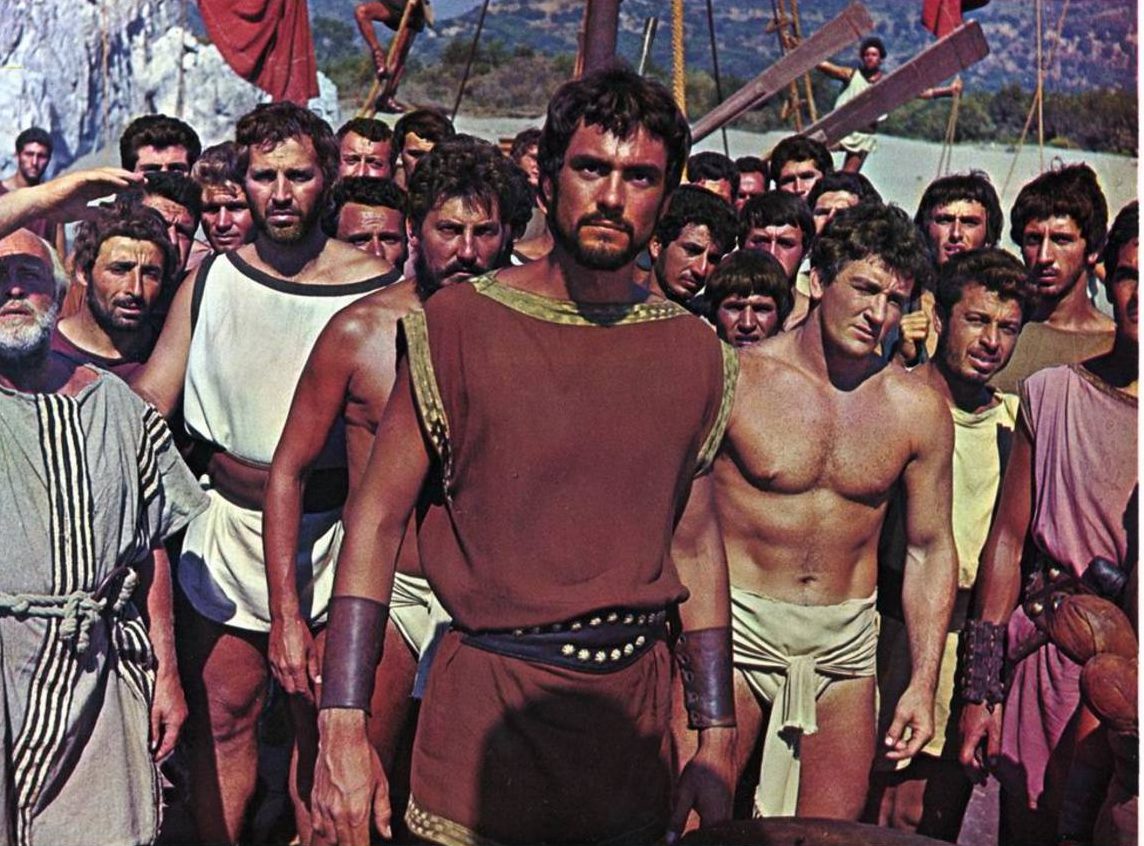
The American actor Todd Armstrong leads a cast of Brits as the relatable Greek hero Jason. Like Jason, Armstrong is athletic, bold and charismatic. It’s unfortunate he didn’t break out as a Hollywood star in the mid 1960s. In his way stood the likes of Paul Newman and Steve McQueen. Though he did beat out British actor Terence Stamp for the title role. But winning the title role of playing Jason did come with some indignity. His voice and that of his co-star Nancy Kovack were dubbed by British actors to keep the accents on screen consistent with the rest of the cast.
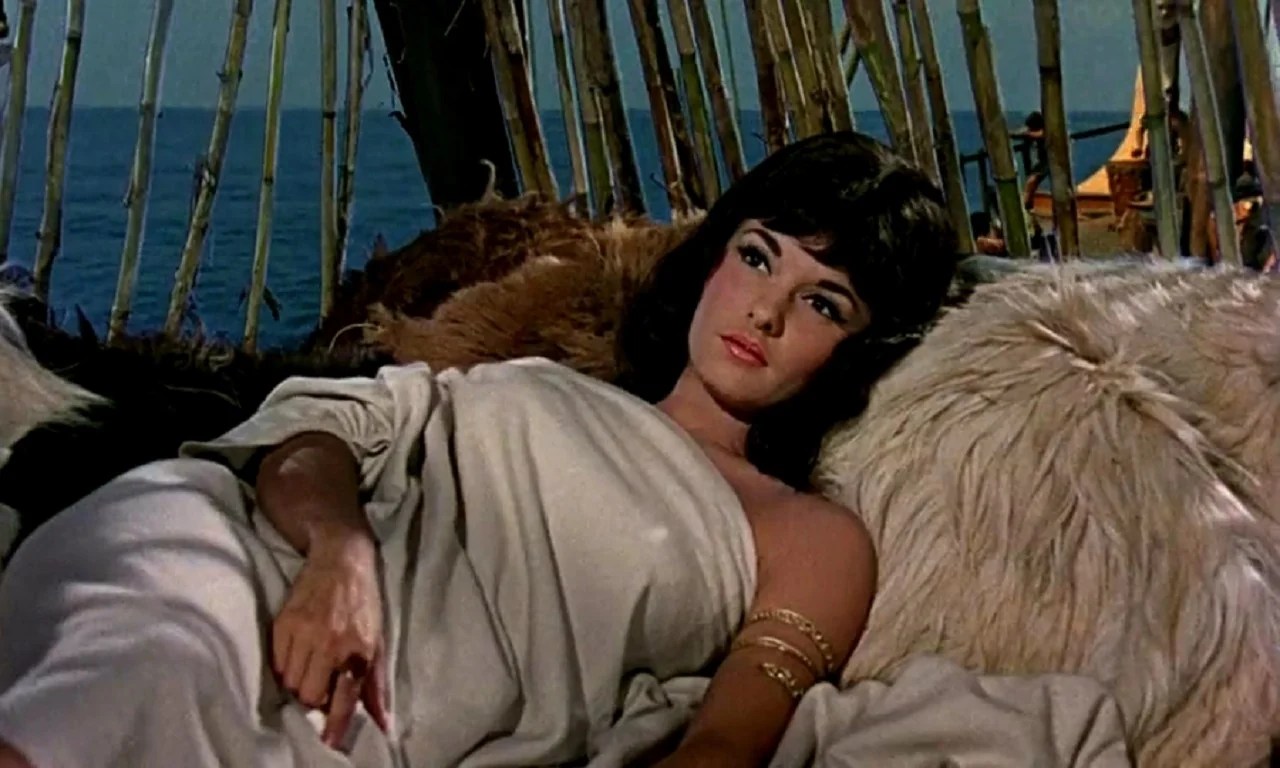
While Armstrong gives a creditable performance, I also cannot fault the film’s supporting cast – Gary Raymond as Acastus, Laurence Naismith as Argus and the imposing 6 foot-4 inches Nigel Green as Hercules. Patrick Troughton is also a standout as the blind seer named Phineas who is tormented by the harpies for his transgressions against Zeus. When Jason encounters Phineas they strike a deal to help each other. Besides Honor Blackman as Hera, Nancy Kovack captivating performance as Medea, the high priestess of Colchis is memorable. Her presence is so magnetic that our attention is fixated upon her. We first encounter her after she is saved by Jason in the aftermath of the clashing rocks scene. That said, there is an air of mystery that surrounds her character and this is no more evident than in the exotic temple dance for the gods, which Medea performs on the island of Colchis to officially welcome Jason and the Argonauts. Here Jason meets her father, King Aeëtes of Colchis, who acts as a gracious host. Though secretly he knows of the plan to steal the golden fleece and soon puts a stop to Jason’s plans. But what he wasn’t counting on was his daughter, Medea, falling in love with Jason and using her sorceress ways to help him escape and steal the golden fleece. But the one thing she cannot escape is her father’s wrath which will become clear in the film’s most famous end scene.
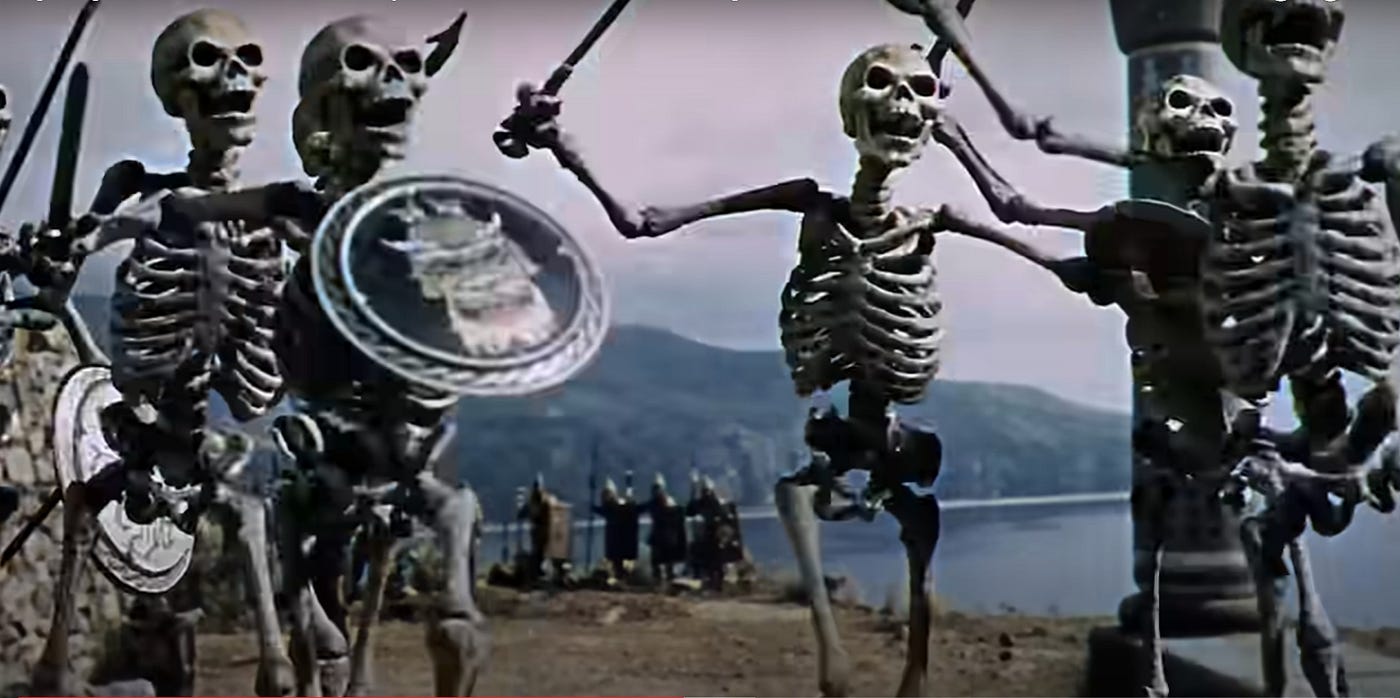
The other notable scene-stealing performance by King Aeëtes of Colchis is played by ever reliable English actor Jack Gwillim whose intense theatrical performance his nothing short of brilliant. He is likely best remembered in this film for his over-the-top theatrics while summoning the Children of the Hydra’s teeth. “Rise up you dead slain of the Hydra. Rise from your graves and avenge us. Those who steal the Golden Fleece must die.” It is here that Aeëtes waits with bated breath for the skeleton army to rises out of the barren earth. I especially love how he thereafter baits the skeleton army to destroy Jason, Castor and Phalerus. He screams “Kill, kill them all!” Moments later they launch themselves with a horrid screeching scream in a fight to the death.
Despite favourable reviews upon release Jason and the Argonauts failed miserably at the box office unable to even recoup its $3 million budget, before finding an enormous, dedicated audience in the decades that followed. In 1964, when Emil Rosa Jr. won the Academy Award for Best Visual Effects for the film Cleopatra over Ub Iwerks work in Alfred Hitchcock’s The Birds, Ray Harryhuasen wasn’t even nominated in the category for Jason and the Argonauts. It’s an incredible oversight. In fact, Harryhausen was never nominated for a competitive Academy Award. Harryhausen and Jason and the Argonauts has since been vindicated by time to be considered one of the most influential fantasy adventure films of all time. Moreover Harryhausen’s honorary Academy Award in 1992 went a long way to correct the historical biases and oversights made by Hollywood.


A great review, Robert!
Fantastic write up of a cinematic high water mark. I first saw Clash Of The Titans at like six or seven and I wanted more more more. This movie was an event for me every time it was on TV. I love it!
Thanks mate. Clash of the Titans was one of the great fantasy movies of my childhood too. Release the Kraken! I still use that phrase around the house.
Haha. Me too. Whenever my dachshund is scratching at the backdoor to bark at a squirrel
One of my mom’s favorite movies. She made sure I knew how great Ray Harryhausen was as a stop motion artist. The skeleton scene still gets us every time.
Such a warm and nostalgic look at this classic — really enjoyed the way you highlighted its sense of adventure.
This was one of our New Years movies as we made our way through Harry Potter, Percy Jackson, then later studying Homer’s work. Thank you so much for reminding me of this sweet memory. I also say Clash of the Titians as kid and Hitchcock’s The Birds as a young adult.
A fun-filled quest. You can’t ask for more!
A great movie and an excellent review
I watched this movie when it came out at the Drive-In. I was amazed. It has my full attention. I loved it.
This is such a great review of a classic film from my childhood. I need to search it out again now…
Sharing…
Thank you for taking the time to read my review. It’s impossible to watch without a smile.
Some old adventure films don’t just tell stories, they ignite wonder. Jason and the Argonauts still feels magical because its heart is bigger than its monsters.
I remember this movie! Great review 🌟
What a classic! I remember this so well and loved every minute of it. My now 24 year old grandson stumbled on it when he visited us at the age of 5 or 6. He was mesmerized. My husband thought it too graphic for him and that little boy was not happy when his grandfather turned the tv off. Great review of a great film.
Thank you for your kind words.
Well deserved! I enjoyed your post very much.
I’m rather very young having watched Jason and the Argonauts but I did. I saw it on a rerun on television and even though I’m part of generation Z, I was amazed by this film.
Today we are able to do everything thanks to CGI but Claymotion still has its charm. I am always in adoration of Ray Harryhausen’s work.
Classic never get old. We should all be inspired by what came before. Thanks for reading.
This one is an incredible movie for me. I loved the use of stop motion and Harryhausen is a true artist that inspired tons of people. And I love the sense of adventure here. It aged a lot well in my opinion.
Also one of my favourite old films. Thanks for the write up.