
Legendary Hollywood actress Eva Marie Saint, who once trained as a teacher, died aged 102 of natural cause earlier this week. I must confess while many journalist are talking up her legacy, you could never really say she was an A-list superstar. The potential was always there, landing her biggest role of her career on debut as Edie Doyle, the noble sister of a murdered dock worker and love interest of Hollywood heavy Marlon Brando in On The Waterfront (1954). Her poignant performance earned her an Oscar for Best Supporting Actress.
Over the next two decades, following her impressive introduction, great roles were few and far between for Saint. In her defence, Saint purposely chose to raise her two children over an all encompassing Hollywood career. Her most notable films include A Hatful of Rain (1957), which shines a spotlight on drug addiction, The Russians Are Coming, The Russians Are Coming (1966), a well received Cold War comedy and Otto Preminger’s large-scale historical epic, Exodus (1960) with Paul Newman. Interestingly, while On the Waterfront is often considered the artistic high water mark of Saint’s career, her stature as an actress rests just as importantly, if not more so, with her role as Eve Kendall, a mysterious double agent, who loyalties are kept secret, until the third act of Alfred Hitchcock’s North By Northwest (1959).
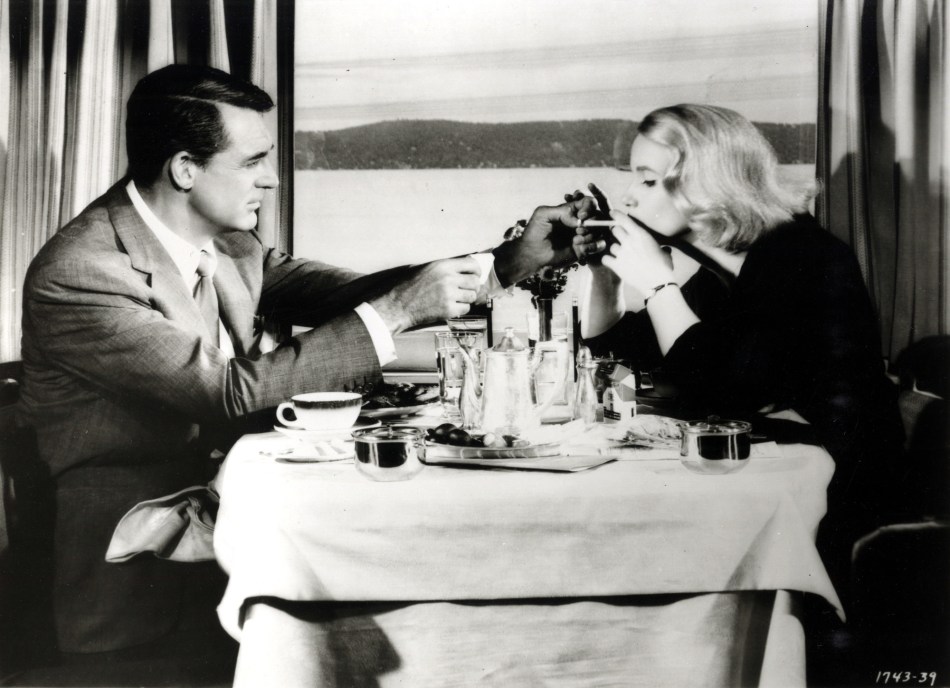
North By Northwest is one of Hitchcock’s best. It stars Cary Grant as Roger Thornhill, an ad executive who gets mistaken for a spy in which the villains of the movie want dead. Thornhill is subsequently forced on the run in an attempt to clear his good name, especially after being framed for a murder he did not commit. While hiding out on a luxury passenger train from his would-be assassins and the police, he meets the mysterious, quick-witted Eve Kendall in the flirtatious dining car scene. Quite frankly it is a masterclass in sexual and narrative tension, which finds Saint going toe to toe with Grant as his come-hither equal.
For years audiences identified Saint’s image with her role as the starry-eyed crusader she played in On The Waterfront. Hitchcock planned to change all that. He cast her for his 1959 American spy thriller movie as a female fatale-type, “Hitchcock blonde” in the mould of Grace Kelly. In behind-the-scene accounts, Hitchcock apparently didn’t give Saint any direction once shooting began, but uttered these famous words to her beforehand: “Lower your voice; don’t use her hands; look into Cary’s eyes at all time.”
The scene in question of this latest instalment of cinema’s greatest scenes begins with Roger being directed by the train steward through the buffet carriage where he is eventually seated opposite Eve. (It was all part of Eve’s plan.) He proceeds to look around the passenger car nervously hoping nobody has recognised him. Wanting for a question that doesn’t arrive, he explains to Eve that he has a familiar face, hence why he is hiding behind his sunglasses. “It’s a nice face,” she notes, which prompts him to remove his shades.
As they continue to trade banter about virtue, physical attraction and other hidden motives, Roger boasts, “The moment I meet an attractive women, I have to pretend I have no desire to make love to her.” Inquisitively, Eve questions Roger, “What makes you think you have to conceal it?” He replies, “She might find the idea objectionable.” “Then again,” Eve declares, “she might not.”
It’s followed by Eve’s revelation to Roger rather proudly that, “I tipped the steward five dollars to seat you here, if you should show up.” To which Roger replies, Is that a proposition?” Kendall coyly interjects and says, “I never make love on an empty stomach.” He looks at her with a wry smile, “You’ve already eaten.” “But you haven’t,” she adds. Roger takes note of Eve’s suggestive hint, raises his martini glass in a gesture of cheers and says, “Think how lucky I am to be seated here.”
When the conversation sudden turns to more formal introductions, both of them answer with a lie. Eve says, “I’m twenty-six and unmarried. Now you know everything.” But when Roger proceeds to tell Eve he is Jack Phillips, she calls him out as a liar. “No you’re not. You’re Roger Thornhill and you’re wanted for murder on every front page in America.” Roger is stunned by the disclosure. But Eve reassures him she has no intention of turning him in to the authorities. She adds that she doesn’t like the book she’s reading and it’s going to be a long night: “You know what I mean?”
The not so subtle pick up line unexpectedly turns into an invitation to meet in her room. It doesn’t take much for Roger to put two and two together. When Eve suddenly draws a cigarette from her purse, Roger feels obligated to strike a matchstick. Their unmistakable chemistry suddenly turns even more intimate, even physical as Eve takes Rogers hand in hers and guides the flame towards her cigarette. The lingering moment ends with Eve blowing out the burning match. It’s followed by a long drag of her cigarette. Eve and Roger look satisfied as if they have already made love. (The old cliche of smoking a cigarette after sex is a cultural trope popularised largely by Hollywood by the 1950s.)
Soon after the train makes an unscheduled stop. Two policemen are about to board the train. It is here that Roger chases after Eve to her private compartment where she ends up hiding him in the upper berth. Later after Eve plays dumb about Roger to the police officers, she unlocks the berth to his great relief. “Why are you so good to me?” Eve looks up at him and smiles, “Shall I climb up and tell you why?”


0 comments on “Cinema’s Greatest Scenes: North By Northwest’s Flirtatious Dining Car Scene.”