
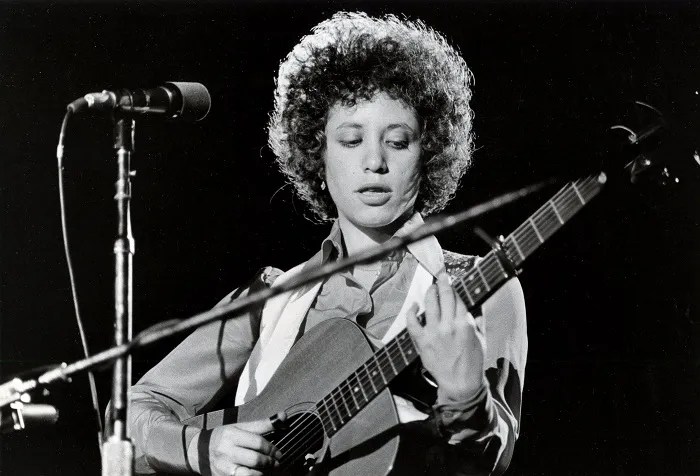
For six decades Janis Ian has captured the depths of life, love and human sorrow in such a profound way that it is truly difficult to ignore her. Along the way she overcame personal demons, homophobia, music industry misogyny and even a life-threatening illness to produce an incredible body of work that still resonates with fans all over the world. In her long career, a number of incredible songs, ranging from her tender 1973 ballad Jesse to Love Is Blind and her late career gem God & the FBI say something about her tenacity, spirit and evolution as a singer songwriter. However she is arguably best remembered for three signature songs that continue to resonate around the globe. Without further ado, let’s break down these three classic songs from her legendary career.
In the year 1966 Jewish teenage singer songwriter Janis Ian released one of the most important songs in music history called Society’s Child (Baby I’ve Been Thinking). It came at the height of the civil rights movement, eventually reaching No.14 on the Billboard Hot 100. Thirty-six years later in 2002, the self-penned song was inducted into the Grammy Hall of Fame. A lot like Sidney Poitier’s groundbreaking film of 1967, Guess Who’s Coming to Dinner, Ian’s song Society’s Child explored the taboo subject of interracial relationships. In an America in the mid 60s where interracial relationships were severely frowned upon, it was a brave song to announce one’s arrival on the music scene. But unlike Poitiers film, Society’s Child doesn’t have a happy ending.
Even in her teenage years Ian’s was a realist. Growing up in a predominately black neighbourhood of East Orange, New Jersey, Ian saw first hand the unimaginable problems such a relationship would throw up. So when the white young girl in her song breaks off her relationship with her African American boyfriend, Ian thought it was the most logical outcome – “I don’t think I made a conscious decision to have the girl cop out in the end, it just seemed like that would be the logical thing at my age, because how can you buck school and society and your parents, and make yourself an outcast forever?”
With Society’s Child launching her career, there was a down side to success. The controversy that it ignited brought hate mail and death threats. She couldn’t even walk in the streets without being spat on. At her concerts she was also vilified by hatemongers. To Ian Society’s Child was just a song and the over the top reaction to it was quite unnerving for the then sixteen year old singer songwriter. As a consequence Ian’s life would spiral. She snorted cocaine with Jimi Hendrix and Janis Joplin, attempted suicide, self harmed and went broke. But her troubles didn’t end there. Ian’s record company Verve and audience all but abandoned her by the time she recorded her fourth studio album Who Really Cares in 1969. Listeners in particular apparently had enough of the self loathing and depressive mood of her songs.
As a result of everything that was going wrong in her life, especially the unflattering reviews and sales of her solitary release for Capitol Records entitled Present Company, Ian withdrew from the music scene in 1971. While she would still write songs behind the scenes, some three years would pass before Ian’s fortunes changed again for the better. Her song Jesse from her comeback album Stars (1974) which first became a moderate hit for Roberta Flack, ultimately helped Ian earn a new record contract with Columbia Records. (Ian recorded seven albums in total with Columbia.) With a new lease of life, moderate chart success with Stars, it wasn’t long before Ian’s next album, Between The Lines (1975) went platinum, largely thanks to the success of her immortal hit single At Seventeen, which reached No.3 on Billboard’s Hot 100.
The song At Seventeen came at a time when Ian was struggling getting work. In fact, she was broke and living at home with her mother. As fate would have it, she stumbled across an article in the New York Times Magazine entitled “I learned the truth at 18” about a young woman who thought her life would change for the better but soon discovered it didn’t live up to her expectations. The article gave Ian an idea about writing a song about teenage angst, something she knew all too well about. With her guitar beside her, she strummed the opening few lines of a potential new song and changed the protagonists age to seventeen.
It took three months to write At Seventeen because Ian was embarrassed about its confessional nature. She was in effect writing about herself and all the feelings that come with seeing oneself as an “ugly duckling”. Eventually overcoming her insecurities about writing such a song, she took it into the studio to record and felt for the first time she had written a hit. After enthusiastically defending her song, especially against the nay sayers who thought it was too long (at nearly five minutes) and supporting it on stage, the song found a like-minded audience who could relate to its themes of adolescent pain, rejection and cruelty. Ian once said, ”At Seventeen is painfully honest, and I sang it with my eyes closed for the first six months because I was so sure everybody would be laughing at me.”
In 1976 Ian won her first Grammy Award for “Best Female Pop Vocal Performance” for At Seventeen. (The song was also nominated for both “Record of the Year” and “Song of the Year”.) It was a major coup for Ian who could have easily disappeared from the charts forever. Whether it was perseverance, luck or the sign of the times, Ian’s At Seventeen captured the essence of this transformative age. Young listeners in particular lapped it up. In 2008, At Seventeen was inducted into the Grammy Hall of Fame, and rightly so.
At Seventeen would be the last time Ian would have a huge hit in the United States. However it didn’t stop her from releasing music in the mid to late 1970s. But by the close of the decade her record label Columbia all but demanded that she change directions musically to remain relevant.
Interestingly, musicians who switched genres during their careers often found success with new audiences. Bob Dylan for instance did the unimaginable in 1965 when he went electric and blues rock albums like Highway 61 Revisted made him a rock icon. Ian did the unthinkable too in 1979 giving herself up to a disco radio-friendly pop song called Fly Too High (1979). Of course, it was nothing to be ashamed of. Many of the biggest 70’s acts like Rod Stewart with Da ya Think I’m Sexy and Blondie with Heart of Glass were venturing out of their comfort zone to find chart success. Interestingly, no one arguably benefitted more from the 70s disco era than The Bee Gees, who transformed themselves from pop pariahs to disco kings.
That said, Ian in her daring new venture collaborated with the “ Father of Disco”, Giovanni Giorgio Moroder to record Fly To High. It was a popular hit in Australia, Belgium, New Zealand and the Netherlands and was a number one hit in South Africa. The song was later included on her Night Rains (1979) album and the film soundtrack to Jodie Fosters coming-of-age film Foxes. Surprisingly, Fly Too High maybe more than any other song outside the US helped launch Ian’s international career. It’s infectious beat, E Street band’s Clarence Clemons sultry saxophone and Ian’s playful lyrics, while not typical of her more serious work, all helped to make it one of the more memorable songs of late 1979 and early 1980. Many of those who admire the song (self included) are particularly smitten by the songs quirky opening line “Anonymous, autonomous/ Will likely get the best of us yet.” While rhyming words and lines like “Dancing and Romancing” and “Hang tail in a new jail, you can go bail,” might also seem cheesy by today’s standards, there is no denying the magic of her delivery.
They say Ian pretty much walked away from music again a few years after arguably creating her most commercial hit in Fly Too High. She would later re-emerged in 1993 with the album Breaking Silence, which earned her another Grammy nomination. At 70, the singer songwriter released what was been billed as her final album, The Light at the End of the Line (2022).
Unafraid of difficult subjects, Ian has left us with an impressive list of songs which say a lot about society and Ian as a person. Many of those songs we have not covered here, but which should be something that you should investigate in your own time. If anything, start with the three songs covered here.


Thanks for the intro, a new name to me!
I LOVE “Society’s Child” and “At Seventeen” so much! I never knew that Ian suffered from such backlash and hate from “Society’s Child”. Some people are so terrible, which is sadly still the case today. Nice tribute to her, Robert.
Interesting, I didn’t really know anything beyond At Seventeen, so an interesting post for me. Interestingly, I had the book Preparing for Adolescence by evangelist James Dobson. He talked glowing about At Seventeen in it.