
When I heard Gareth Edwards was going to direct a new Star Wars movie in the mid 2010s, I thought who the hell is this guy. I literally had to look him up. The first thing that came across my screen was his 2014 film Godzilla. I watch it. I liked it, particularly Edwards’ character-driven approach and restraint, and especially how he built upon all the anticipation and dread leading to Godzilla’s proper introduction about halfway through the movie.
As a big fan of George Lucas’ universe, I really enjoyed Rogue One: A Star Wars Story (2016). Edwards did an admirable job behind the camera despite all the drama around Disney being in a panic about his director’s cut prior to Rogue One’s release. I hate how Disney did little to defend Edwards. In particular they declined for years to comment on why exactly they hired Tony Gilroy to do extensive rewrites and reshoots, especially the sacrificial ending, until the man himself (Gilroy) spoke out about it. According to Gilroy he saved Rogue One. (Those of you who are unfamiliar with Gilroy, he would later become the showrunner, head writer and executive producer of Rogue One‘s 2022-2025 prequel TV series, Andor.)
It’s important to remember Edwards didn’t write the screenplay for Rogue One. He was a hired gun who had to work within Disney’s pre-established vision for the film. That said, Edwards has always called his involvement with Gilroy as collaborative. (It’s not the first time Gilroy has been brought in to contribute to an Edwards production. Gilroy provided uncredited, late-stage script rewrites to Godzilla.) Yet it is interesting how Edwards would have to suffer through years of rumours (not corrected by Disney or Gilroy) about who did what. In recent years Edwards effectively denied being sidelined during the reshoots and had to make a statement to correct all the falsehoods around it.
Edwards in particular has been gracious about the opportunity he received from Disney to direct a Star Wars movie. I think he said it was something like a dream come true. In my opinion, Edwards has also been very careful and or calculated in his criticism of Disney, so as to not ruin his carefully laid plans as a working writer and director in Hollywood. While his follow up The Creator (2023) for New Agency and Entertainment One was a long time coming, he was still allowed to showcase his talents without the restrictions of studio interference.
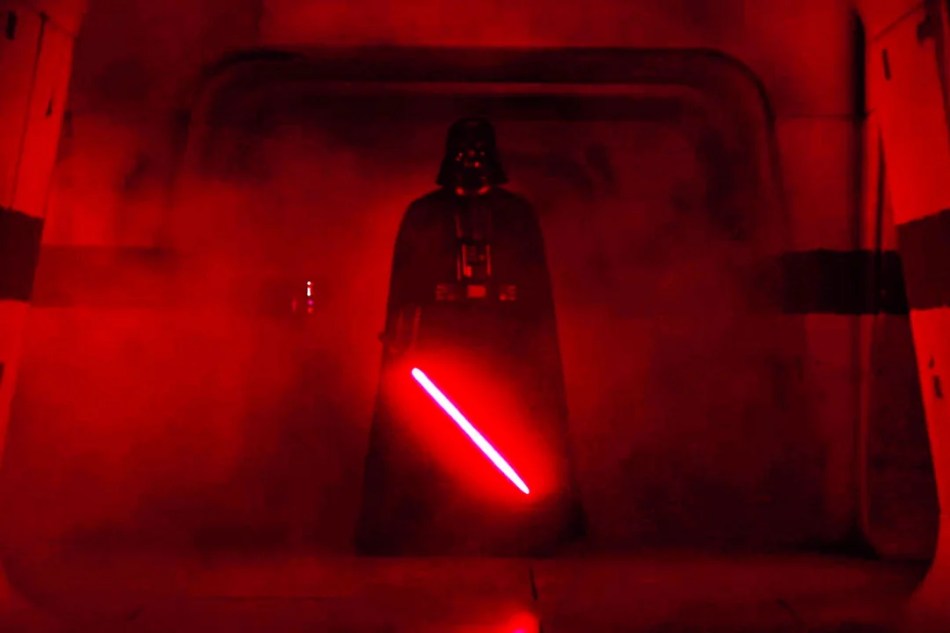
While I hate getting bogged down in all the negativity that comes with Rogue One’s notorious reshoots, the one thing the Gilroy-led do-overs allowed Edwards to do was to add one final, high stakes scene showcasing Darth Vader in a terrifying sequence, which would create a direct narrative bridge into the opening scene of A New Hope. The scene that I allude to is Darth Vader’s ruthless corridor massacre.
Many years ago, I included it in my 10 best moments in all of Star Wars. You can read about it HERE. Back then I said: “Over the years, Star Wars fans turned to books and comics to visualise what Darth Vader might have look liked at his zenith. But it was never fully realised until fans actually got to see the full extent of Vader’s power in Star Wars: Rogue One. The merciless onscreen slaughter of rebel troops in his attempt to retrieve the stolen plans of the Death Star left almost everyone including critics gobsmacked. Interestingly, this iconic Rogue One scene almost didn’t happen. It is my understanding that it was a complete afterthought. In a ballsy move months out from the release of the film, Rogue One editor Jabez Olssen and director Gareth Evans felt something was amiss with its ending, so they pitched the idea of Vader going berserk on the rebel Calamari ship to executive produce Kathleen Kennedy. She surprisingly absolutely loved it and the scene was shot and the rest they say is Star Wars history.”
Despite many spiteful rumours, such as Star Wars luminary Dave Filoni directed the iconic Darth Vader sequence, none of them are true. Insider pushback and finally Edwards rescuing his own reputation, set the record straight. “The very last thing that we filmed in the pickup shoot was the Darth Vader corridor scene,” Edwards clarified in 2023. “I did all of that stuff.”
One of my favourite moments in the corridor scene comes early, whereafter an initial scrabble by rebel soldiers, they hear a menacing, mechanical breathing sound in the darkness. The absolute blackness is subsequently fractured by the shriek of an igniting lightsaber. Here Darth Vader stands glowing in red sillhoutte as his foes look on in horror. When Vader begins his unhurried approach, deflecting laser fire with his lightsaber, while pushing and hurling rebel bodies at will (with the force), the hapless rebels are not only stunned but terrified.
This, and the whole sequence, works so well on many levels. From the palpable sense of panic of the rebels, the claustrophobic feel of the corridors to Vader’s destructive rage and the handoff of the stolen Death Star plans to Princess Leia, this end scene embodies everything we love about the excitement of Star Wars. Edwards even manages to give himself a cameo as the rebel soldier who pulls the corridor lever to help launch Tantive IV into hyperspace.


One of my favorite scenes in Star Wars history. The most terrifying Darth Vader has ever been.
Third best Star Wars movie IMO, after IV and V.
It definitely rates highly on my Star Wars best movies list.