
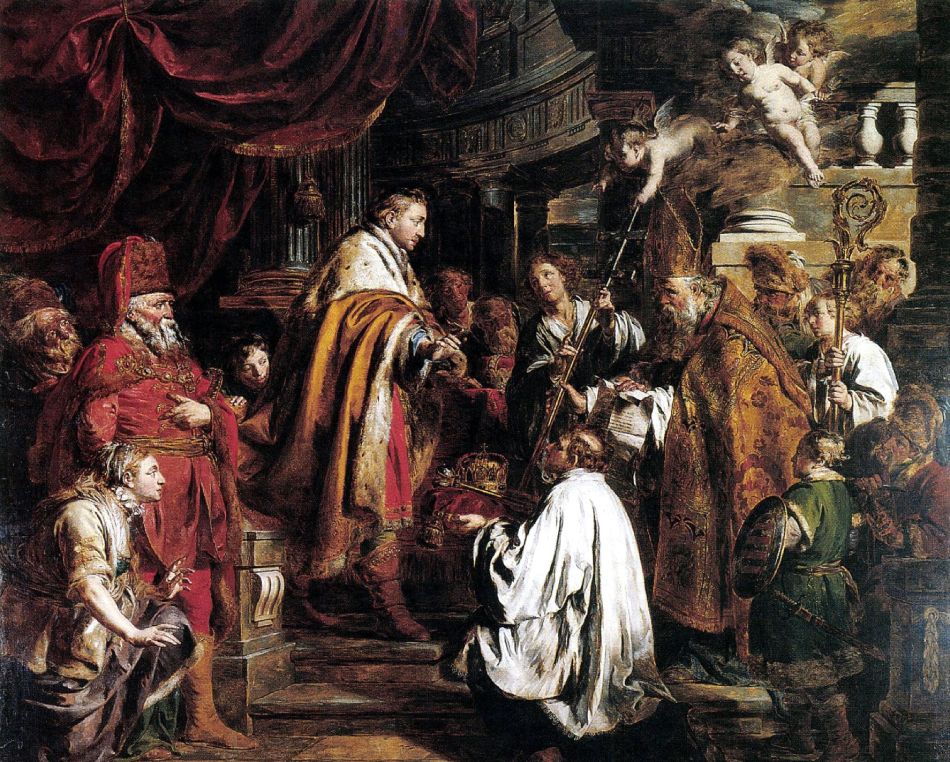
This painting might fall under the genre of religious art but it is also a history painting, a dynamic composition depicting the coronation of St. Stephen. It is titled ‘Saint Stephen, King of Hungary receiving the legate’. It was painted presumably in 1770 by Flemish painter Pieter Jozef Verhaghen (1728-1811) who was a large scale painter of religious and mythological scenes. He produced over 300 works of art during his lifetime, of which many are still on display in Belgium. His history painting of St Stephen receiving the Pope’s envoy is typical of the warm, rich colour schemes of Flemish Baroque. His use of vibrant reds and golds in particular is used to highlight the fine detail, quality and importance of the drapery and the lavish attire worn by the Hungarian lord, Stephen I of Hungary and the Pope’s cardinal. The liturgical vestment worn by the cardinal adorned with gold thread embroidery is interesting in itself. Here Verhaghen wants us to know this is no ordinary representative sent by the Pope. Hence the elaborate heavenly robes. Historically, cardinals have frequently coronated rulers outside of Rome, and in the year 1000 or 1001 CE this was the case in the coronation of the first king of Hungary.
What excites me the most about this history painting is a small but all important detail which helps grandstand the significance of this occasion. In the centre of the painting you can see a magnificent carved rock crystal sceptre and a crown being offered to Hungary’s first king. What we are looking at here is the supreme centrepiece of the Hungarian Crown Jewels. More specifically, my attention is fixated on the Holy Crown of St. Stephen, also known as the Holy Crown of Hungary.
It is said that true legitimacy as a Hungarian king, hinged on being crowned with the Holy Crown. Over the centuries fifty Hungarian kings received the crown upon their coronation. (King Charles IV was the last monarch to be crowned with St. Stephen’s Crown in 1916.) Interestingly, the Holy Crown was likely remodelled or augmented from its original shape in the 12th century. The Holy Crown itself has two distinct parts, an upper part known as the Latin crown and the lower part known as the Greek crown. Some theorists even propose that the Holy Crown is not made of two seperate crowns but has always been a uniquely single crown gifted by the Byzantine Emperor Michael VII Doukas to King Geza I of Hungary in the 1070’s. However, according to Hungarian legend, there is another story in which the jewelled crown was sent by Pope Sylvester in the year 1000/1001 CE to Hungary to crown its first christian king. In another version of events, it is also said that Stephen boldly sent his archbishop to Rome to acquire the crown from the Pope. Of course, we will never truly know the truth of the matter.
The quality and craftsmanship of the gold crown is exquisite, decorated with enamel pictures. While we cannot make out the detail from Verhagen’s painting, the front of the crown shows Christ enthroned in his rightful place as ‘ruler of mankind’ and flanked by archangels Michael and Gabriel and other warrior saints. The reverse of the crown depicts the Byzantine Emperor Michael VII at the peak of the crown, with his son and heir Romanos to his right, and on the left, King Geza, lower in rank or status to both the Emperor and his son. Interestingly, even though it was meant as a gracious gift to Geza, welcoming him as a Byzantine ally, it was in many ways also a ‘slap in the face’, highlighting his place in the pecking order of rulers, below Christ and Emperor Michael.
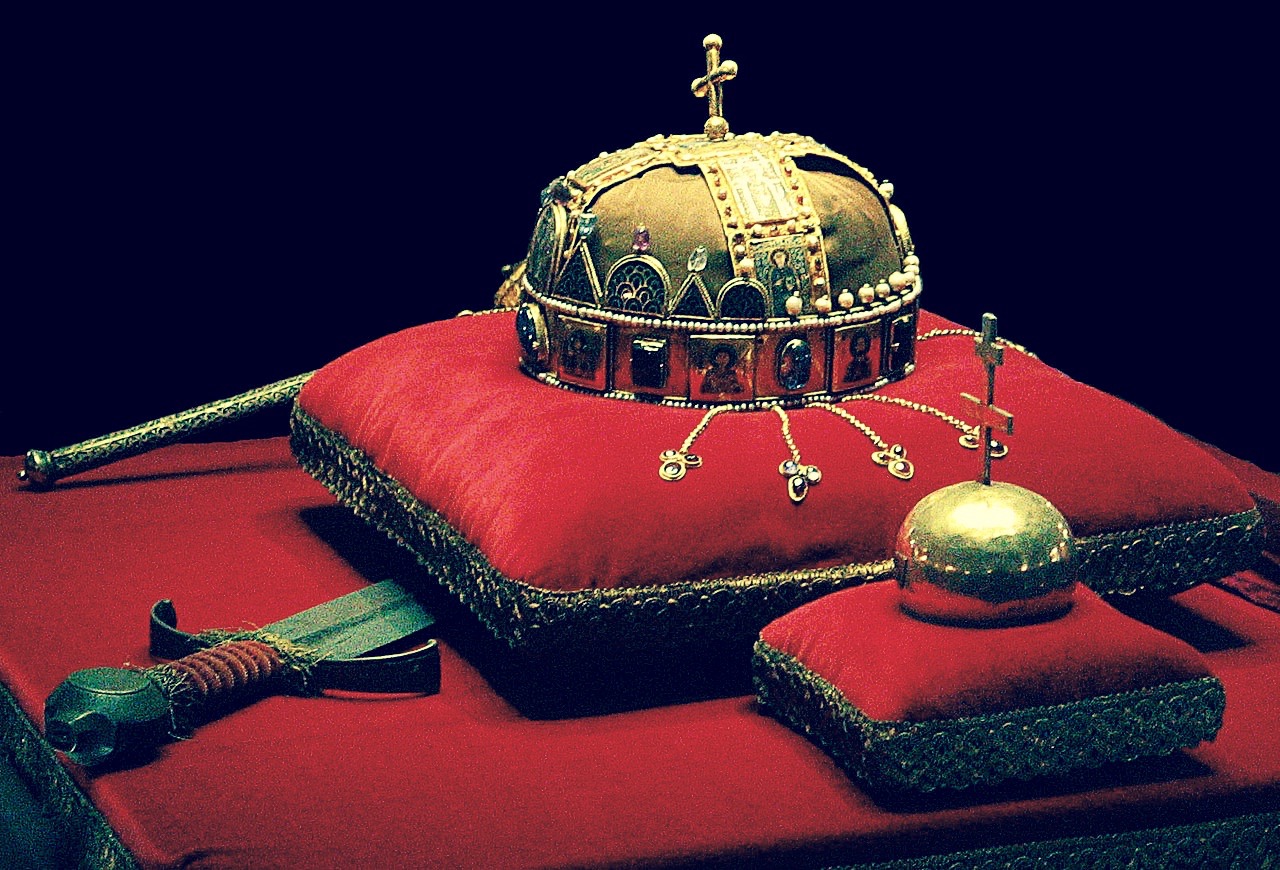
Be that as it may, there can be no doubt that the Holy Crown has played an integral part in the history of Hungary. For over a millennia it has stood as a precious symbol of Hungarian sovereignty and unity and rightly so. When it was sent away for safekeeping to the United States after the Second World War because of fear that the Soviets would get their hands on it, its absence was mourned for over thirty years. Eventually, under the Carter administration, in the late 1970s, it was returned to the people of Hungary. It is said that people wept in joy during the return ceremony.
Today, the Holy Crown sits on display in the central Dome Hall of the Hungarian Parliament Building. But, it is unlikely that the Holy Crown that currently presides in Budapest is the original papal crown. Pierre-Joseph Verhaghen’s history painting is also found in Budapest at the Museum of Fine Arts. I imagine he would be thrilled that his large-scale painting has a special place in the hearts of Hungarians.
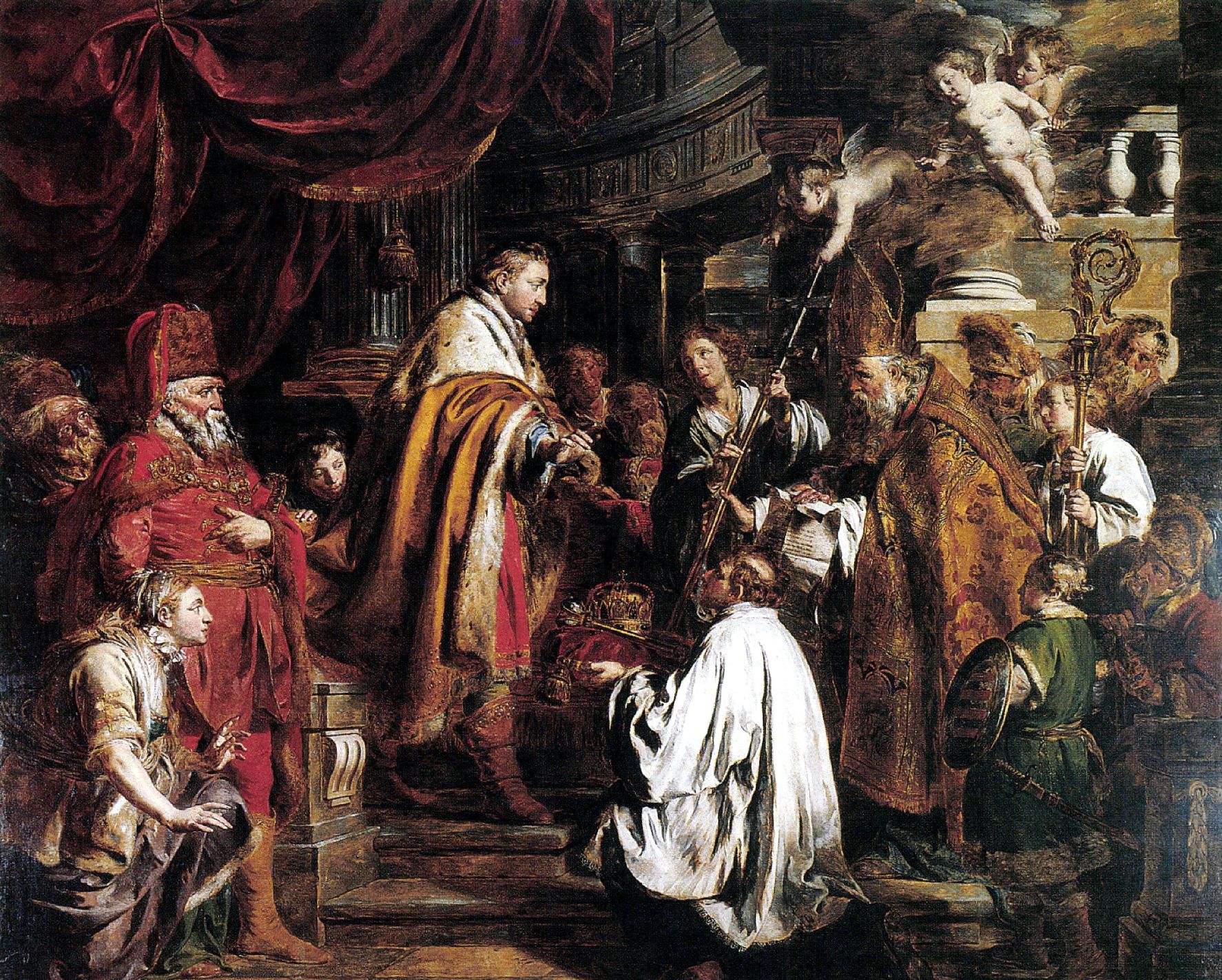
Photo Credit: Pierre-Joseph Verhaghen’s history painting is in the public domain. The image of the Holy Crown of St. Stephen with sword, scepter and globus cruciger of Hungary is used under the Creative Commons Attribution-ShareAlike 3.0 license.
*The core of this featured article was originally written in November 2018 and formed the basis of a now defunct short article I had written on the Holy Crown of St. Stephen. It has since been edited and expanded into this new article for my History Painting series.


0 comments on “History Painting: ‘Saint Stephen, King of Hungary receiving the legate’ by Pieter Jozef Verhaghen, 1770.”