

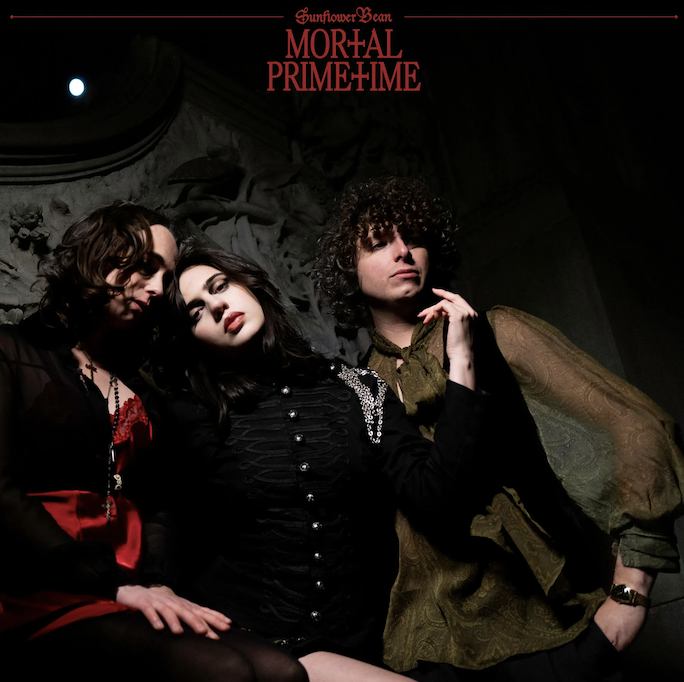
For a better part of a decade, Sunflower Bean – composed of vocalist and bassist Julia Cumming, guitarist and vocalist Nick Kivlen, and drummer Olive Faber – have attracted a devoted following thanks to their sophisticated alt-rock leanings, pairing affecting vocals with swells of guitar and distortion and a rolling drum sound. The New York trios latest record Mortal Primetime interestingly marks a new creative peak. While it may take a listen or two for the melodies to fully unfurl, once they do it’s impossible to ignore the exciting energy of tracks like Champagne Taste and Nothing Romantic as Sunflower Bean loosen up. But Mortal Primetime arguably shines brightest in its most restrained moments. Take for instance the ballad Waiting For The Rain or the introspective There’s A Part You Can’t Get Back, which sees them dig a little deeper than usual into the things that matter most.
As Sunflower Bean gear up for the US leg of their current tour, I recently caught up with band drummer Olive Faber to talk about their new record, self-producing and what one venue they’d love to play but haven’t yet. Here is some of what we talked about.
Olive, it’s exciting to see Sunflower Bean reach a new creative peak. A lot of these songs on the new album have so many facets to them. It makes for a rewarding listen?
I think so, it’d be a bit boring if it was all the same. Although a lot of my favorite records do kinda play through as one song. I think it comes down to the story that’s being told, just like a book, or a movie, or a painting.
A lot of fans will attach themselves to these new songs just as they did on your previous records. What do you want listeners to feel when they hear Mortal Primetime?
I’m not really sure. I think that’s up to the listener. When I listen to the record I feel a sense of life and death, happiness and misery, and the catharsis that comes from being face to face with it.
What inspired the name of your new album?
Naming a Sunflower Bean record is a funny thing because it has to be consensus from a few different individuals. I think we were looking for a title that summarized the meaning of the record.
Your music often delves into the complexities and challenges life throws at us. Could you tell us which song on the album hits home the most and why?
Sunshine is definitely the one for me. I think it really encapsulates the feeling of being “so happy” and having things that you want but also still being so sad.
Do you ever feel the impulse to lean into your influences, only to shy away from it and create something totally unexpected. Is there an example of this on the new album?
The way to use influences is kind of as a guiding light, not as a goal. I love making music and records because you can have the whole thing mapped out in your head as much as possible but it will always end up somewhere else. Leaving space for the unknown is one of the most important parts of making a record.
You’ve already released a couple of great singles, Nothing Romantic and There’s A Part I Can’t Get Back. For those who don’t know, what are the stories behind both these singles?
Nothing Romantic is a song about rejecting the romance of being alone. Like i think we all kind of can get wrapped up in being lonely, and making sense of it by romanticizing it. But at the end of the day loneliness sucks. – Olive
There’s A Part I Can’t Get Back is a song about things happening to you in your in past and accepting that you are changed because of it. A lot of times we want to say that we’re okay in spite of things that have happened, but sometimes your just not, and thats okay too.
When it comes to your guitar sound – which is incidentally one of my favourite things about the band – who are the guitar virtuosos or bands who have influenced your sound? Moreover, could you tell us a little bit more about the guitar gear and tones created for Champagne Taste?
Led Zeppelin, The Kinks, Nirvana, Alice in Chains are all bands that have influenced our guitar sounds, amongst so many others. The thing that is in common about all the sounds is simplicity. This record we tracked all the guitars through the same amp and cab, with same mic, just switching a few pedals. When you create some boundaries when recording you can really focus in and get what you’re looking for.
I understand your self-produced your new album. What were some of the compositional, performance and production challenges you enjoyed or felt overwhelmed by?
Producing is the easy part. We took a classic, simple approach by tracking everything live as the 3 of us and then doing a handful of overdubs that we had already planned out. I think producing is about organizing and limiting. Keep your palette small and in order and it will be a breeze. It will let you focus on the performance and the strength of the composition, and make things that aren’t working very apparent so you can just scrap it and move on. Momentum is extremely important when producing, you gotta keep things moving forward.
You are currently on tour. What’s your biggest takeaway from touring aboard? How are audiences different to say New York?
Audiences are definitely different everywhere you go. We were just in England and its amazing how much rock music is a part of mainstream culture there. Like we don’t have that in the US. For better or worse, I’m not sure, but it’s definitely cool to see it appreciated in a different way.
Finally, what’s one venue you would love to play but haven’t yet?
Im sure it wouldn’t even be that great because playing stadiums is whatever, BUT, being from NYC, headlining Madison Square Garden is kind of the ultimate goal.
 Rearview Mirror
I really like their sound!