
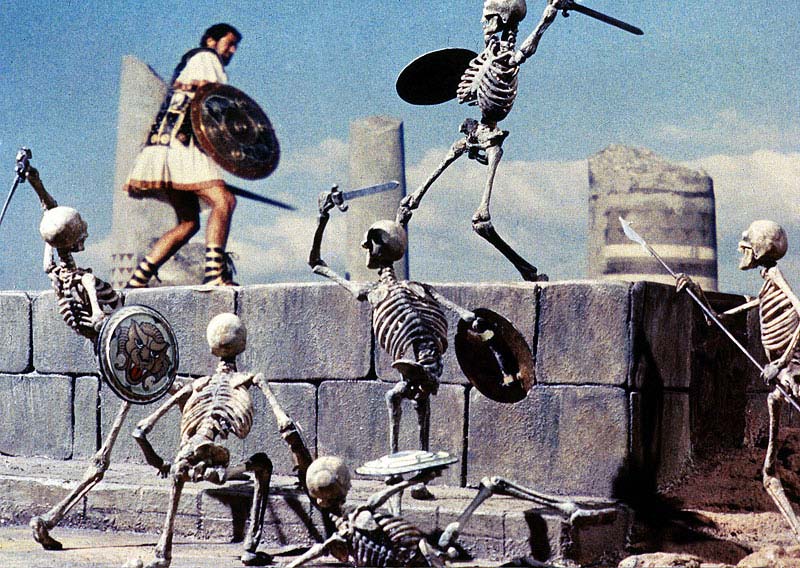
No-brainer films like 1963’s Jason and the Argonauts are right up my ally. Old films like these hold a special place in my heart. It was a time when special effects were lets say wonky at best. But that’s what made them exciting and visceral even if today’s audiences sneer at their outdated technology. But no matter what some people might think, many of us believe there is still a special place for stop motion animation as an art form. I’d love to see a Star Wars devotee complain about the holographic chess scene in the original 1977 Star Wars: A New Hope. Guess what? It was created by stop-motion master Phil Tippett (and Jon Berg). While Tippett is a legend (his career spanning decades beginning with Star Wars), when it comes to special effects everyone bows in recognition to Ray Harryhausen as one of the most influential and greatest technicians of all time.
Ray Harryhausen (1920-2013) was born in Los Angeles, California but lived most of his adult life in the United Kingdom. In Hollywood as a boy he met his mentor pioneer model animator Willis O’Brien after seeing King Kong when he was aged 13. Encouraged by O’Brien, Harryhausen honed his skills in graphic art and sculpture and would later work with O’Brien as an assistant animator on Mighty Joe Young (1949). In 1953, Harryhausen became a one-man show in charge of all the stop-motion sequences of the fictional dinosaur monster film The Beast from 20,000 Fathoms (1953). This was also the first film which saw him pioneer the process that became known as Dynamation wherein pre-shot action sequences (usually with actors) was integrated with his animated models.
Harryhausen would later design and give life to some of the most celebrated stop-motion fantasy and monster sequences of all time. The famous cyclops in The 7th Voyage of Sinbad (1958) always come to mind, so does the Medusa sequence from the Clash of the Titans (1981), but his animation in Don Chaffey’s Jason and the Argonauts, is widely regarded as his best work ever, contains several iconic sequences, most notably the creaking 100-foot bronze giant Talos scene and the months-in-the-making skeleton battle sequence.
How do you bring to life a bag of bones? One frame at a time, Harryhausen would’ve probably said. In fact he was truly up against it, especially with the skeleton battle sequence, having to remember the intricate movements of not just one or two skeleton warriors but seven! Often he had no idea what it would all look like until months later when it was edited into a coherent sequence. He once said that this sequence alone was his most complex.
The scene in question scene comes late in the film after Jason (played by Todd Armstrong) has stolen the legendary Golden Fleece under the nose of King Aeëtes. Trying to flee the Kingdom of Colchis, Jason is eventually cornered by the scornful King Aeëtes. Not only is King Aeëtes enraged with Jason for stealing the Golden Fleece but that he killed the venomous seven-headed Hydra, the guardian of the sacred grove where the Golden Fleece was kept. To avenge the theft and the slaying of the Hydra, King Aeëtes threatens Jason with an outstretched handful of the Hydra’s teeth. “Rise up you dead slain of the Hydra. Rise from your graves and avenge us. Those who steal the Golden Fleece must die.”
Following these ominous words Aeëtes proceeds to sow the Hydras teeth upon the barren clifftop. As the tension builds, from the ground seven skeletons emerge, one by one. Here Jason, Phalerus, and Castor stand in disbelief and ready to fight, while companions Medea and Argus escape with the Golden Fleece. When the shrieking skeleton army finally jumps and strikes at our heroes they are immediately on the back foot. Jumping up on walls and temple foundations, the army of skeletons with their wielding swords and shields are hard to defend against as Jason, Castor and Phalerus kick and slash at will. Soon Castor and Phalerus fate is sealed as they are outmanoeuvred and killed by the smiling murderous skeletons.
As Jason life now hangs by a thread, seven against one (!), the immediate question on my lips and probably everybody else at this point is how do you defeat them? Earlier on, when one skeleton is stabbed through the ribs, another decapitated and a third slashed at by Jason (and is seen lying lifeless), the odds it seems has finally shifted in our heroes favour. But time after time, the skeletons (literally!) rise to the occasion. In the end when Jason is left standing cornered on the edge of a cliff, he decides to do something rash and jumps off into the sea to escape. Here the skeletons at last meet their maker as they tumble over in pursuit of our hero. While it might feel like an anticlimax, if anything it is a fitting and hilarious ending to the scene.
In Harryhausen’s biography ‘An Animated Life’ with Tony Dalton, he wrote, “We puzzled over this conundrum for some time and in the end we opted for simplicity by having Jason jump off the cliff into the sea, followed by the skeletons. It was the only way to kill off something that was already dead, and besides, we assumed that they couldn’t swim. After filming a stuntman jump into the sea, the prop men threw seven plaster skeletons off the cliff, which had to be done correctly on the first take as we couldn’t retrieve them for a second. To this day there are, somewhere in the sea near that hotel on the cliff edge, the plaster bones of seven skeletons.”
And so it seems not only was Harryhausen arguably the last great animator, he was also a wonderful storyteller and dreamer. Thank you, Ray Harryhausen.
 Rearview Mirror
0 comments on “Cinemas Greatest Scenes: When Jason and the Argonauts battle the Skeleton Warriors.”