
In its infancy, motion pictures were marked by a lot of groundbreaking firsts. For instance, the first ever motion picture (sort of) was Eadweard Muybridge’s The Horse in Motion in 1878. The first Western movie? The Great Train Robbery (1903)? You would think so. But new evidence now points to the British short Kidnapping by Indians (1899) as the first Western. What about the first widely recognized Science Fiction movie? Most film historians agree that honour belongs to A Trip to the Moon (1902), also a groundbreaking first, directed by the legendary French filmmaker Georges Méliès, who helped to evolve film as a medium into an art form. And what about Christmas as a theme which inventors and filmmakers could exploit. The first Christmas movie? That honour goes to the British silent film Santa Claus, directed by George Albert Smith in 1898, with a running time of 1 min and 16 seconds. It was followed by 1900’s The Christmas Dream (again George Méliès was involved in weaving his magic) and others like Scrooge, or Marley’s Ghost (1901) and The Night Before Christmas (1905), starring Harry B. Eytinge as Santa Claus.
The latter is importantly a 1905 American silent short film directed by American film pioneer Edwin S. Porter, the same visionary who brought us The Great Train Robbery. Porter’s The Night Before Christmas was inspired by the poem “A Visit from St. Nicholas” (also often referred to “The Night Before Christmas”). It was first published anonymously in 1823 and is generally attributed to American writer and scholar Clement Clarke Moore. While Porter’s short film is not the first Christmas movies ever made, it is instead the very first film adaption of Moore’s famous tale.
With a running time of 9 minutes, by today’s standards The Night Before Christmas would be too short to be called a movie. Interestingly, its short running time was the norm during those early days of filmmaking. Produced by the Edison Studios it was made quickly and inexpensively with Porter’s incredible experience as a projectionist. Porter, by his own admission, once said he was influenced by the likes of George Méliès. It is easy to see, especially in the scene where Santa’s sleigh is pulled over the hills through thick snow and into the sky (a painted backdrop with a moon no less) with handsome miniature cut outs as reindeers.
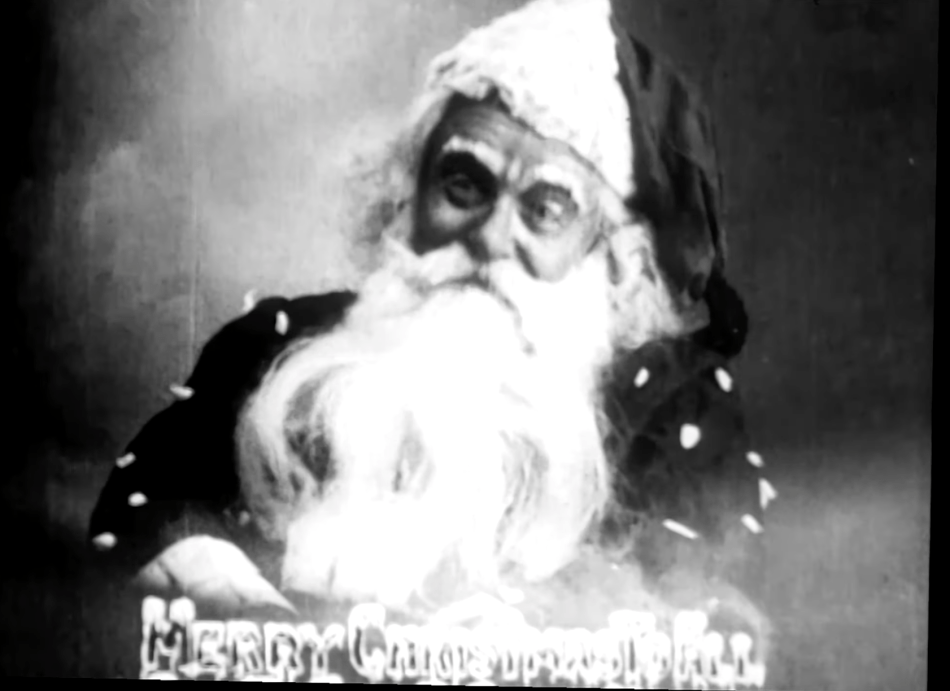
And what of the plot? It follows the story of a household of children preparing for bed on Christmas Eve. But they are obviously too excited to go to sleep in anticipation of Christmas Day. Soon the children are running amok in their bedroom with an amusing pillow fight with feathers flying everywhere. Meanwhile, Santa is busy feeding his reindeer and preparing gifts in his workshop for children all around the world. He even finds time to strike out names on his naughty and nice list. Before long we observe Santa as he takes off in his sleigh. We are told “So up to the house-top, The coursers they flew. With sleigh full of toys and Saint Nicholas too.” At Santa’s first stop, he climbs down the chimney into the household we first meet earlier and fills all their stockings, even magically producing the biggest fully decorated Christmas tree on Earth! The next to last scene concludes with happy children playing beneath the tree with their Christmas presents. And at the end of it all, Santa’s wishes the audience a Merry Christmas of course.
Please note there are various versions of the musical accompaniments online for The Night Before Christmas. For the silent version of Porter’s surviving film print see HERE.
 Rearview Mirror
Happy New Year, Robert!