

Whenever you think of the word revolution what conjures up in your mind first? The fall of the Bastille? The Bolsheviks? The Boston Tea Party? If you recalled at least one of these you would be right. But, of course, there are many more. In its broadest sense, revolution has come to mean some form of sudden radical change like overthrowing an old regime or institution with a new one. With this in mind I am reminded of the long list of revolutions that have played out over the long course of human history.
The largest of the early revolutions that interest me the most is the French Revolution of 1789-99. Historian A.J.P. Taylor points out, it started quietly enough yet turned into one of the most famous political upheavals of all time. It was more than simply the overthrow of the French monarchy. Who wouldn’t want to learn and make sense of something like that?
One of the earliest events that shaped the French Revolution was the storming of the Bastille on 14 July 1789. The Bastille was a royal armoury, fortress and prison in the centre of Paris. As an ever present reminder of French royal authority and oppression, revolutionaries attempted to storm and seize control of the Bastille. As the situation deteriorated the Governor of the Bastille tried to avoid direct conflict with the insurgents, all the while considering their demands for the release of prisoners and the surrender of arms (some 250 barrels of gunpowder). However as tensions rose between the belligerent parties, a series of misunderstandings and distrust led to the collapse of negotiations. The garrison housed in the fortress had no choice but to open fire on the out of control mob. Almost one hundred civilian insurgents were killed before the Bastille’s Governor and his garrison eventually surrendered to the demands of the revolutionaries, which included a small contingent of French Guards (around sixty) who mutineered for the cause.
The insurgent victory which saw the capture of the Bastille (which was subsequently demolished) and the release of prisoners from its walls was more than just a knee jerk reaction. It was a clear defiance of royal authority. When news broke of the Bastille’s capture and carnage (including the succeeding execution of Governor de Launay), King Louis XVI of France at Versailles apparently asked, “Is it a revolt?” to which the Duke of La Rochefoucauld replied, “No, sire. It’s not a revolt. It’s a revolution.”
Choosing just five history paintings here below which depicts the storming of the Bastille was a challenge. I hope I have chosen a good mix which captures the historical moment and sentiment associated with one of French history’s most important days.

This history painting by an anonymous artist happens to be my favourite of the storming of the Bastille paintings. Despite everything that is going on in the painting, our eye is first drawn to what is happening to the right of the painting. Here we see Governor Bernard-Rene Jourdan de Launay (upon surrender) being led away by insurgents and rebel French Guards. I also love the detail of the tall round towers. The stones seem perfectly placed. The Bastille itself soars over everything and a moat protects the fortress, which we unfortunately cannot see in the painting, but the gate which protects the inner courtyard is visible with its drawbridge down. Here insurgents climbed the long roof of the building next to the gate and smashed the chains of the drawbridge. How accurate the detail of the image is, we will never know. It might help if we knew who the artist was. They might have actually been an eyewitness to this historic event.
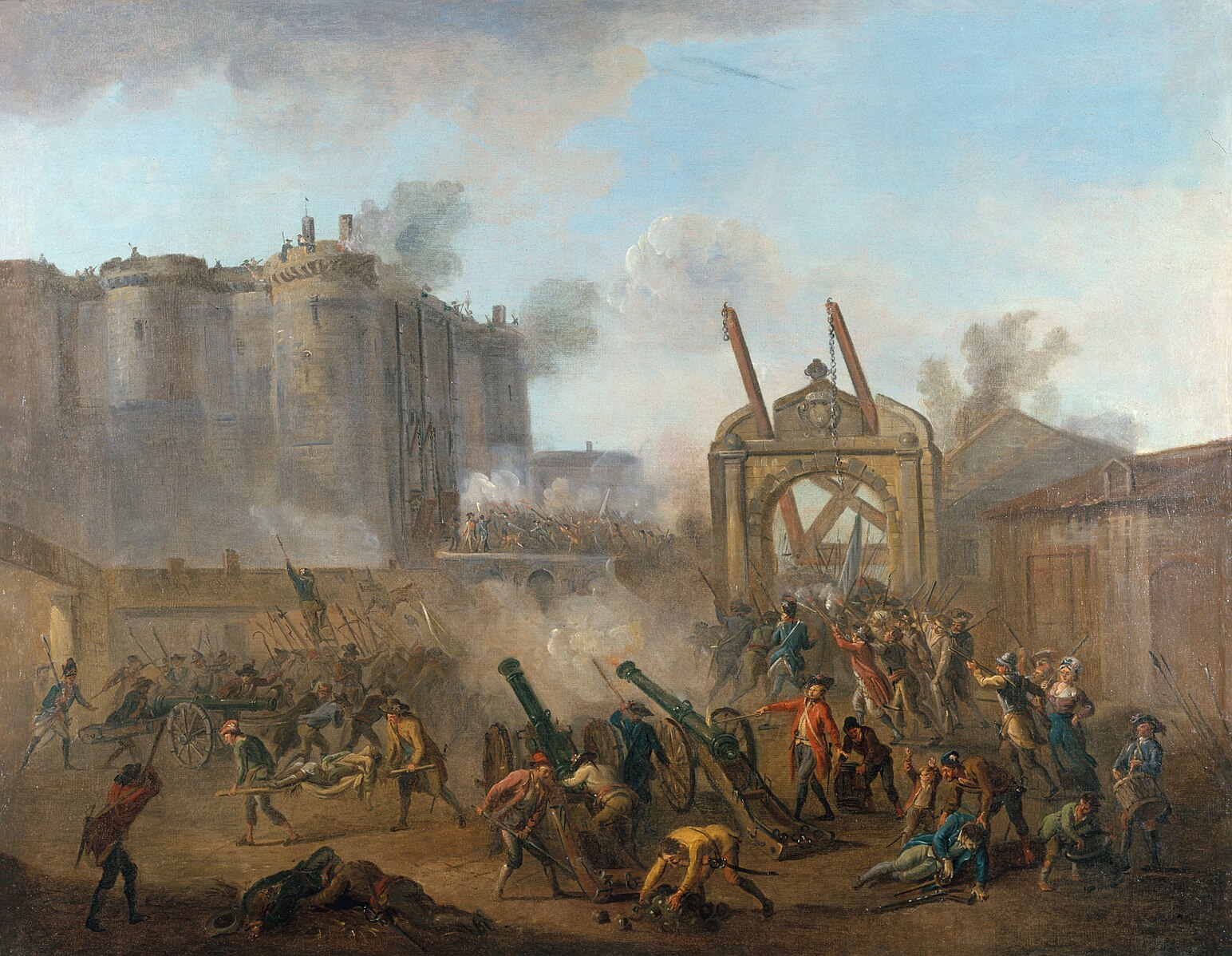
Somewhat little is known of the life of French born painter and draftsman Jean-Baptiste Lallemand. However we know for example he settled in Paris (apart from his brief stints in Italy and England) and it’s possible he was in Paris during the storming of the Bastille in 1789. Moreover throughout his career, he painted views of Paris and it’s possible the detail we see (especially the layout of buildings) in his history painting are accurate. The painting itself shows a scrappy battle scene with insurgents and mutinous French Guards (in blue uniforms) desperately trying to gain the upper hand against Governor de Lauanay’s Bastille troops. There seems to be two tiers of fighting. In the foreground insurgents are carrying the wounded out and firing cannons which rebel French Guards confiscated. In the inner courtyard there seems to be a stampede along the narrow bridge leading to the fortress (which apparent stood some twenty five metres high). It’s an exciting action scene depicting the bravery of ordinary Parisian men.
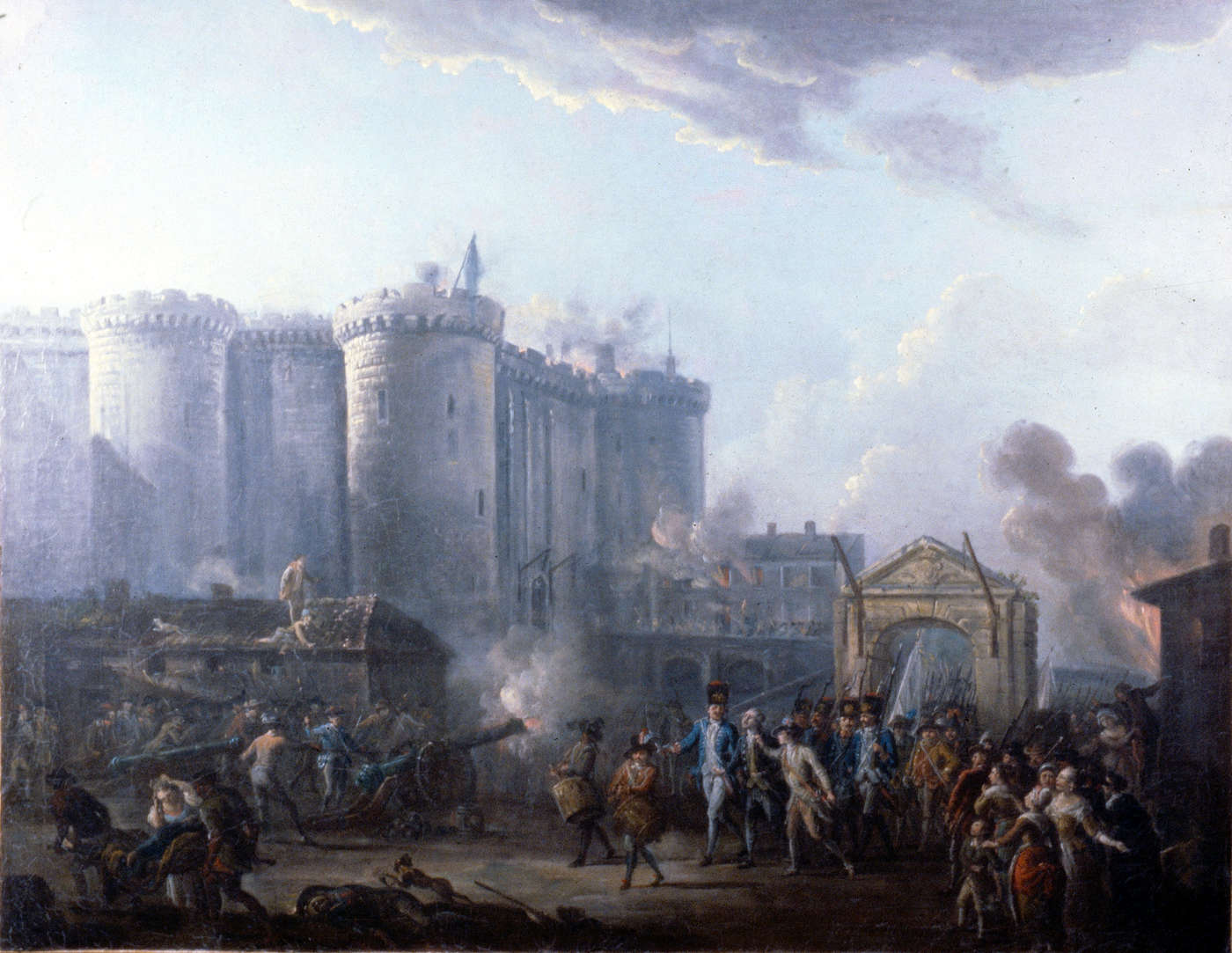
Frenchman Jean-Baptiste Lallemand apparently painted two scenes of the storming of the Bastille. The first was The Storming of the Bastille in 1789 (scroll back up) and the second ‘Arrest of the Governor of the Bastille’ in 1790 (presented here). Interestingly, Lallemand remains faithful in how he sets up the scene, especially the position of the fortress, the outhouse and the gate which protect the inner courtyard. This painting however has one major difference to his previous effort, our view of Governor de Launay being escorted away by French Guards is new. There are cannons here too, which are manned by rebel French Guards. Interestingly, the cannon closest to the centre-left appears to be emitting a large burst of flame and smoke. It has likely contributed to the fire that’s seemingly raging in the building on the far right. Upon closer inspection, all the smoke in both of Lallemand’s paintings seem to be attributed to cannon fire, but we also know for fact that the insurgents also set fire to two wagons filled with damp straw, in an attempt to obscure their movements from enemy. However, the clouds of smoke everywhere proved to be more of a hindrance than an advantage and eventually the wagons were hailed away.

In the British artist’s history painting ‘The Storming of The Bastille’, Henry Singleton focuses our attention squarely upon the mob which has collapsed in front of the drawbridge gate. In it a strategically place cannon seems to be firing a round at the tall towers, while in the foreground two women watch in horror as a guard helps a wounded man. On the far right a guard waves what looks like a French royal flag with three distinct gold flour-de-lis upon it. It’s possible that these guards are the mutineers of the French Guard who joined the fight alongside the insurgents.
The insurgents or revolutionaries, around one thousand in total, who stormed the Bastille were mostly craftsmen and store owners who lived in Paris. They were members of a French social class called the Third Estate. They would later earn the title “Vainqueurs de la Bastille”, meaning Winners of the Bastille. They are still celebrated every year on Bastille Day, a national holiday in France, along with the Republics core values of liberty, equality and unity.

This is the epic history painting by Charles Thévenin which was first exhibited at the Salon of 1793. It’s extraordinary for a number of reasons. Most importantly, against the backdrop of cannon fire, wounded and dead revolutionaries, we see a small party of Parisian citizens take captive the Bastille Governor, Bernard René Jourdan, marquis de Launay. Here the insurgents are angry and rightly so. A massacre took place right before their own eyes and most believed it was de Launay who was responsible for it. In Thévenin painting it’s frightening how angry the mob surrounding de Launay are acting. The insurgent in particular with his back to us is about to rip off de Launay’s uniform. And to de Launay’s right, a loyal guard has an insurgent’s rifle with a bayonet thrusted at his throat.
While not depicted in this scene, Governor de Launay’s sword and baton of rank were stripped from him too. Not long after this he was heavily beaten by the furious mob. At one point de Launay cried out, “Enough! Let me die!” and kicked an insurgent in the groin. It sparked a vicious response which led to him being stabbed to death. Afterwards his head was fixed on a pike and paraded through the streets of Paris before being tossed into the Seine.
Governor de Launay was born within the Bastille walls in 1740. As a boy he was appointed to an honorary position in the King’s Musketeers. When he was older, he joined the French Guards Regiment stationed at the Bastille. In 1776 de Launay succeeded his father as Governor and led apparently an uneventful life in charge of the Bastille until the fateful day the fortress was stormed by revolutionaries.
The header image is the painting ‘The Bastille During the First Days of its Demolishment’, 1789. It was created by French painter Hubert Roberts. It was first exhibited at the Salon of 1789 at the Louvre in Paris. Today it resides in the Musee Carnavalet in Paris. The decision to demolish the Bastille was made by the Permanent Committee of Municipal Electors at the Hôtel de Ville in 1879.
 Rearview Mirror
0 comments on “5 Fascinating History Paintings of The Storming of the Bastille.”