
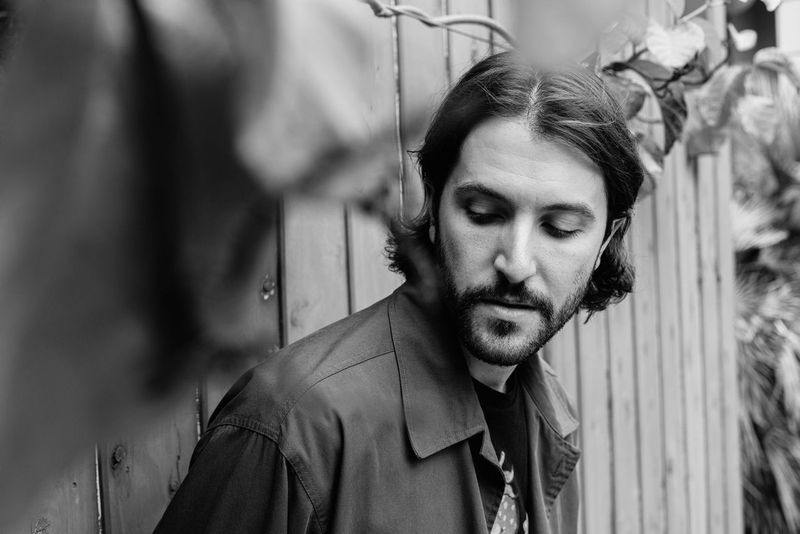
Lance Gurisik is a conservatoire-trained Australian composer who dabbles in electronica, often playing at festivals and venues around the world (under the name Lancelot) and releasing music under his own name. Last year, his debut album, Cull Portal, was well received for its innovative blend of jazz, electronica and contemporary orchestral elements. The Guardian’s music critic John Lewis called it “startling” and “dazzling”. What I like about Gurisik is that he isn’t scared to venture into territory an ordinary, typical music listener might not know too much about. Some might call what he does a niche, but when you sit down to listen to an album like Cull Portal, it really is surprisingly rewarding with its mesmerising soundscapes.
Today, Gurisik’s highly anticipated sophomore album, Proffer was released. It too, challenges the prevailing norms in the music industry. Our friend John Lewis was again impressed with Gurisik’s latest offering, particularly singling out the album’s orchestral tracks. I was privy to a sneak peek at the album. While I don’t often sit down to listen to an instrumental electronica album like Proffer, I was still captivated by its otherworldly charm. From beginning to end it felt like I was on a visceral listening journey.
I recently caught up with the Australian composer behind Proffer. Here is some of what we talked about.
Lance, could you tell us a little about yourself and how music has changed your life?
I’m a composer, producer, and DJ based in Sydney, Australia. I work full-time as a screen composer and write music for my own projects whenever I can find a spare moment. I also have a cat named Gio—he’s the best! Pasta and wine are my favourite combo.
Music has changed my life in countless ways. It gives me purpose and allows me to express myself and my ideas in a way that feels authentic. I find so much joy in the process of making music—whether it’s crafting the sounds, arranging the pieces, recording, or obsessing over the finer details. Creating music brings me a deep sense of inner peace. Even when I’m not actively working on music, I’m constantly thinking about it.
Combining jazz, electronica, and contemporary orchestral music is a unique blend. Do you consider your target audience when creating?
It might be niche in Australia, but there’s definitely an audience for this style in larger regions like Europe, the UK, the US, and Japan. I don’t really consider a target audience when creating—I make music to satisfy my own creative urges, hoping that others will enjoy it too. I think that approach makes it feel more genuine and unique. My music is meant to be a vehicle for escapism and self-exploration through active listening. Both of my albums are designed to be listened to from start to finish, like a journey.
What was your first synthesizer, and how has your setup evolved over time? Do you have a favourite synth right now?
The Minimoog Voyager was my first real synth. I’ve always had a love-hate relationship with it. Before creating this album, I dove into the world of modular synthesis—a real rabbit hole! I particularly love Verbos Instruments and have several of their modules. They’re inspired by the Buchla approach to synthesis, which is quite different from the Moog world, but the sounds you can create are incredible. My favourite is probably the Harmonic Oscillator.
Do you remember the first time you heard a synthesizer in a song? How did it make you feel?
I’m not sure I remember the very first time, but one of the earliest memories is hearing analog synths as a major part of a track’s production in “Kelly Watch The Stars” by Air. I remember watching Channel V and MTV when I was about 10 or 11 and thinking, “Wow, you can make music without guitars!”
Wang Chung’s soundtrack for the film ‘To Live And Die In LA’ opened my eyes to the possibilities of popular musicians working in film. Is that something that interests you?
Oh, definitely! I’m waiting for the day Denis Villeneuve or Gaspar Noé calls me to score one of their films! It’s amazing to see musicians like Trent Reznor, Nils Frahm, and Oneohtrix Point Never, who started in the record industry, successfully cross over into film. I work as a full-time screen composer here in Sydney, but I haven’t yet had the chance to work on big cinematic releases—yet.
At what point did you realize the music you were developing for Proffer would benefit from a collaborative team?
I had a big vision for this project that required a broad palette of sounds and instruments that I don’t play but know how to write for. I love writing for strings and work with the same string players regularly, which is great. The entire project was recorded remotely during the Covid lockdown, so it’s amazing how well it turned out.
Have you ever found musical inspiration from something totally unexpected?
I think limitations are the best kind of musical inspiration. Without them, it’s too easy to get overwhelmed and never start anything.
Can you tell us about any challenges with this new record that really pushed you to your limit?
I was almost trying to “break” the tracks to see how far I could push them. I worked on “Glut” for nearly two years, from the initial idea to final production. I’ve never re-recorded parts so many times before! “Changes” also took a long time—it was originally written on the Juno 106 and sounded like something Vangelis would have composed for an ’80s film. I’m glad I eventually recorded strings for it.
If you had to choose one track that encapsulates your sound and the new album as a whole, which would it be?
That’s tough, maybe even impossible… but if I had to choose, I’d say “Glut.” It’s a homage to the American minimalist composers I was exposed to at the Conservatorium—people like Steve Reich, John Adams, and Terry Riley. I wanted to explore that musical language in a contemporary way, blending it with influences from Alice Coltrane’s take on spiritual jazz. The track is trance-like and cyclical, affecting how your brain interprets the music.
What’s the best advice you’d give to someone starting out in electronica?
Get really good at one DAW (Digital Audio Workstation). It doesn’t matter which one—just master it.
As a musician who enjoys working with analog synths, what are your thoughts on the future of music, especially with the rise of AI-generated music?
I hope it gets weirder and leads to new genres we haven’t heard yet. Music today often feels homogenized—songs are shorter, some even under two minutes, with some starting right at the chorus. People want that instant gratification, or they skip tracks, treating music as a secondary activity. Hopefully, AI will make people appreciate musicians and creators even more. But when AI can create music indistinguishable from human-made tracks… that’s going to be a terrifying reality.
Finally, what would you say is the perfect setting for listeners to enjoy your music?
A cave.

 Rearview Mirror
Lance is a thoughtful and talented composer and musician. His music is alternately haunting and joyful, contemplative and cinematic, compelling and whimsical. I like it!
Some great stuff there Robert, thanks for the intro. A good read too.